
Introduction
One of the most crucial steps in establishing a strong and trustworthy business is registering under GST. Many business owners think GST is only about tax rules, but in reality, it can open new doors, increase customer trust and make your business look more professional.
Think of register for GST as giving your business a proper identity, just like putting a nameplate on your shop or office. It tells your customers, suppliers and partners that your business is genuine and ready to grow. Whether you sell offline or online, GST registration can help you work smoothly and unlock bigger opportunities.
In this blog, we will explain the key benefits of register for GST in simple words. And to make your business process easier, we provide expert GST registration services to help you submit documents correctly, complete the application and receive your GST number without any stress.
What is GST Registration
GST registration is the official process of getting listed under the Goods and Services Tax system. Once your business is registered, you receive a unique GSTIN (Goods and Services Tax Identification Number). This number appears on your invoices and helps the government identify your business for tax-related purposes.
Any business that crosses the mandatory turnover limit must register under GST. However, even smaller businesses can choose to register voluntarily, as it brings many benefits, such as improved credibility, eligibility for online sales, and access to input tax credit.
With GST registration, you can:
- Legally collect GST from customers
- Claim tax credit on purchases
- Sell on online marketplaces
- Work with bigger companies and corporate clients
- Expand your business across states in India
Note: If you do not register for GST even when your turnover requires it, your business may face penalties and restrictions. That’s why it’s important to register on time.
Classifications according to GST turnover
Under the GST system, businesses in India are divided into different categories based on their annual turnover. These categories help business owners understand whether GST registration is mandatory, optional or if they can choose a special scheme like the composition scheme.
1. Turnover below threshold (small business not required to register)
- Goods: Up to ₹40 lakh (some states have a ₹20 lakh limit)
- Services: Up to ₹20 lakh (some states have a ₹10 lakh limit)
Businesses below these limits are not required to register under GST unless they choose to register voluntarily.
2. Above Threshold limits (Mandatory GST registration)
GST registration becomes compulsory when a business crosses these limits:
- Goods: More than ₹40 lakh
- Services: more than ₹20 lakh
Once a business crosses the threshold, register for GST is legally required.
3. Composition scheme
This special category is designed for small businesses that want a simple tax system with lower tax rates and less compliance.
Eligibility limits:
- Traders & manufacturers: Turnover up to ₹1.5 crore
- Service providers: turnover up to ₹50 lakh
Under this scheme, businesses pay tax at a fixed lower rate and file fewer returns, but they cannot claim input tax credit (ITC)
4. Special exemption category (small service provider)
Small service providers with a turnover of up to 20 lakh get full GST exemption. Businesses within ₹20-50 lakh can choose the composition scheme for service, which offers a lower tax rate and simplified compliance.
5. E-commerce sellers (Registration mandatory, no turnover limit )
If a business sells on online platforms like:
- Amazon
- Flipkart
- Shopify
- Meesho
- Zomato/Swiggy (for food businesses)
Then, GST registration is mandatory, even if turnover is below the threshold.
Types of GST in India
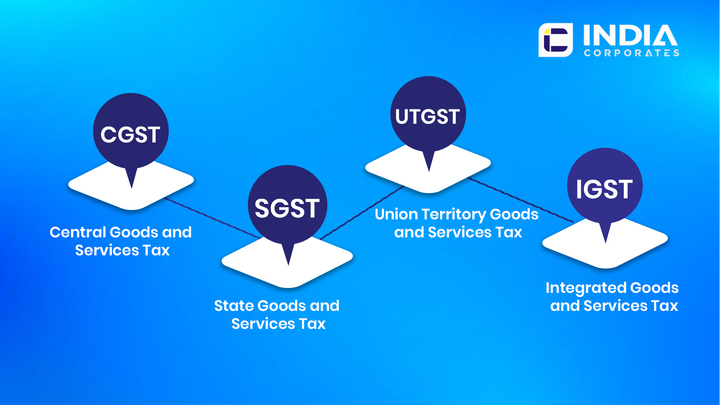
GST in India is divided into different types based on how tax is collected and shared between the central and state governments. Even though GST is single unified tax, it is split into four categories for smooth administration and transparency.
1. CGST- Central Goods and Services Tax
CGST is a tax collected by the Central Government on the sale of goods and services within the same state.
Example: If you sell a product within your own state, part of the GST you charge goes to the central government as CGST.
2. SGST- State Goods and Services Tax
SGST is collected by the state government on the same sale within the state.
Example: If you sell goods in your own state, GST is split into CGST+SGST, where SGST goes to your state government. [CGST + SGST apply only on intra-state (within the same state) sales].
3. IGST- Integrated Goods and Services Tax
IGST is applied when goods or services are sold from one state to another. This tax is collected by the central government and later shared with the destination state.
Example: A seller in Maharashtra selling to a buyer in Karnataka will charge IGST. IGST applies only to inter-state (one state to another state) supplies.
4. UTGST- Union Territory Goods and Services Tax
UTGST is applied in Union Territories without a legislature. It works similarly to SGST but applies only in UTs. It is applicable in:
- Andaman and Nicobar Islands
- Chandigarh
- Dadra and Nagar Haveli and Daman and Diu
- Lakshadweep
- Ladakh
In these areas, GST is charged as CGST + UTGST
Understanding the different types of GST is important because it enables small businesses to operate smoothly. It enables you to create accurate GST invoices, file returns correctly, avoid penalties, and understand how taxes are shared between the central and state governments. If you are confused about which GST type applies to your business, we can help you with complete GST guidance and end-to-end GST registration support.
Benefits of GST registration
1. Legal Recognition of Business
Getting GST registered gives your business a legal identity. It shows that your business is officially recognised by the government and operates honestly. This makes customers, suppliers and banks feel more confident about working with you. When your business is legally recognised, it becomes easier to open bank accounts, sign contracts and deal with bigger companies that prefer working only with registered businesses.
2. Ability to collect GST from customers
When your business is registered under GST, you can charge GST on products or services you sell. This means you follow proper tax rules and do not have to pay taxes on your own earnings. Charging GST also keeps your billing system clear and professional. It helps avoid confusion with customers since everything is shown clearly on the invoice.
3. You can claim input tax Credit (ITC)
One of the biggest benefits of GST registration is the Input Tax Credit. This allows you to subtract GST you paid on purchases from GST you collect on sales. This helps you save money and reduce your overall tax cost. You only need to keep proper bills and invoices to claim credit. ITC supports better record-keeping and helps your business become more organised financially.
4. Easier access to loans and business funding
Banks and lenders trust GST-registered businesses more because they can check your sales and income through GST returns. These returns act as proof of your business activity. This makes it easier to get loans, credit and other financial support when you need it. If you want to grow your business or manage your daily expenses, register for GST can greatly improve your chances of getting funding.
5. Participation in interstate sales without restrictions
Before GST, selling goods in another state involved many different taxes and complicated paperwork. GST removed these problems and made interstate trade much simpler. With GST registration, you can easily sell your products or services anywhere in India. This opens the door to new markets, more customers and higher sales without facing extra tax barriers.
6. Improved business credibility and trust
A GSTIN on your invoices helps customers trust your business more. It shows that you follow rules, pay taxes and operate correctly. This kind of trust is very important for small businesses, especially when you want to grow or compete with larger brands. When customers see official details on your bills, they feel safer buying from you.
7. Validity for Government tenders and contracts
Most government departments and big companies require businesses to have GST registration before applying for tenders or contract work. Without GST, many goods will be missed. Once your business is registered, you can apply for large-scale projects that offer better income and long-term stability. This is especially helpful for service providers, traders and contractors.
8. Easier compliance with tax laws under one system
GST brings many different taxes into one system, which makes tax compliance easier. Instead of dealing with several types of taxes, you only need to understand and file GST. The entire process is online, which saves time and reduces paperwork. This simple structure helps small businesses avoid mistakes and stay on the right side of the law without hiring costly experts.
9. Option to expand business nationally and online
GST registration is required for selling products on e-commerce platforms like Amazon, Meesho, Flipkart and Shopify. If you want to expand your business across India or start selling online, GST becomes essential. With GST, you can ship products anywhere in the country and grow your brand beyond your local area. This creates many new opportunities for small businesses.
10. Seamless flow of Goods and services across states
GST has made the movement of goods faster and more efficient. Earlier, trucks had to stop at multiple checkpoints for tax-related inspection. Now with GST, these barriers are gone. This means fewer delays, lower transport costs and quicker delivery to customers. A smoother supply chain helps you manage your business better and improves customer satisfaction.
How India Corporates simplifies GST registration for small businesses
Getting GST registered can feel confusing, especially for small business owners who are busy with daily work. We make the whole process easy and stress-free by guiding you at every step. We aim to help you get your GST number registration without confusion, delay or extra trouble. Here is how we make it simple:
1. Simple document help
We tell you exactly which documents you need and explain everything in easy words. If something is missing, we help you arrange it most simply.
2. Easy online application
We fill out the GST form for you and submit it online. This saves time and helps avoid mistakes that can slow down the process.
3. Step-by-step guidance
You don’t have to figure out anything on your own. We guide you from beginning to end and keep you updated, so you always know what is happening
4. Quick fix for any issues
If any correction or extra step is required, we handle it fast. This helps your application move forward smoothly.
5. Basic GST learning support
After your GST number registration is approved, we explain how to use it, like making GST bills, checking your GST details and understanding simple rules.
6. Help even after registration
Our support doesn’t stop after you get your GST number registration. You can contact us anytime if you have questions or need help with basic GST tasks.
Conclusion
GST registration may seem like a small step, but it can bring big advantages for any small business. It helps you gain legal recognition, build customers’ trust, and open doors to new markets across India. With benefits like input tax credit, easier interstate sales, smoother online selling and better chances of getting loans or government contracts, GST registration services give your business the support it needs to grow.
By becoming register for GST, you make your business more professional, more organised and more prepared for future opportunities. In today’s competitive market, having a GST number is not a requirement; it is a smart move that can help your business run smoothly and reach new heights.

No comments yet