Simplify Your Company Registration

Launching a new business is exciting, so registering it should be easy. Submit your documents once, and our experts will handle the complete registration process for you.

When you choose us, you’re not just selecting a service provider; you’re partnering with a dedicated team of professionals committed to business success. Our mission is to help you launch efficiently and remain fully compliant from day one.

Why Choose Our Company Registration Service

Complete Online Process

Complete Online Process

No need to do manual paperwork.

 Expert Support

Expert Support

Our professionals handle all legal filings and compliance.

Affordable Packages

Affordable Packages

Transparent pricing with no hidden charges.

Quick Processing

Quick Processing

Get your company registered in just a few working days.

Register Your Company in India

Company registration is the legal step to officially start your business with government recognition. After registration you get a Certificate of Incorporation and a CIN (Company Identification Number), and your business becomes its own separate entity.

Whether you're starting Private Limited Company, LLP or One person company, we make your registration fast, easy, and 100% online.

Registering a company in India is the first and most important step toward legally starting your business. Under the Companies Act 2013, any individual or group can set up a business for lawful activities by following the rules of the Ministry of Corporate Affairs (MCA). Once registered, your business gets a unique legal identity with several rights and protections under Indian law.

Certificate of Incorporation
Unique Legal Entity
Unique Legal Entity

Choosing the right business structure is important; it will affect your daily operations, compliance work, and long-term goals. You can register as Private Limited Company, Limited Liability Partnership (LLP) or Sole Proprietorship, depending on your business needs. Each type offers different benefits in ownership, flexibility, and legal protection. Company registration in India also helps you gain government benefits, legal recognition, and market credibility.

Our Simple Process

Consultation & Business Structure Selection

Consultation & Business Structure Selection

We understand your business goals and help you choose the right type of company.

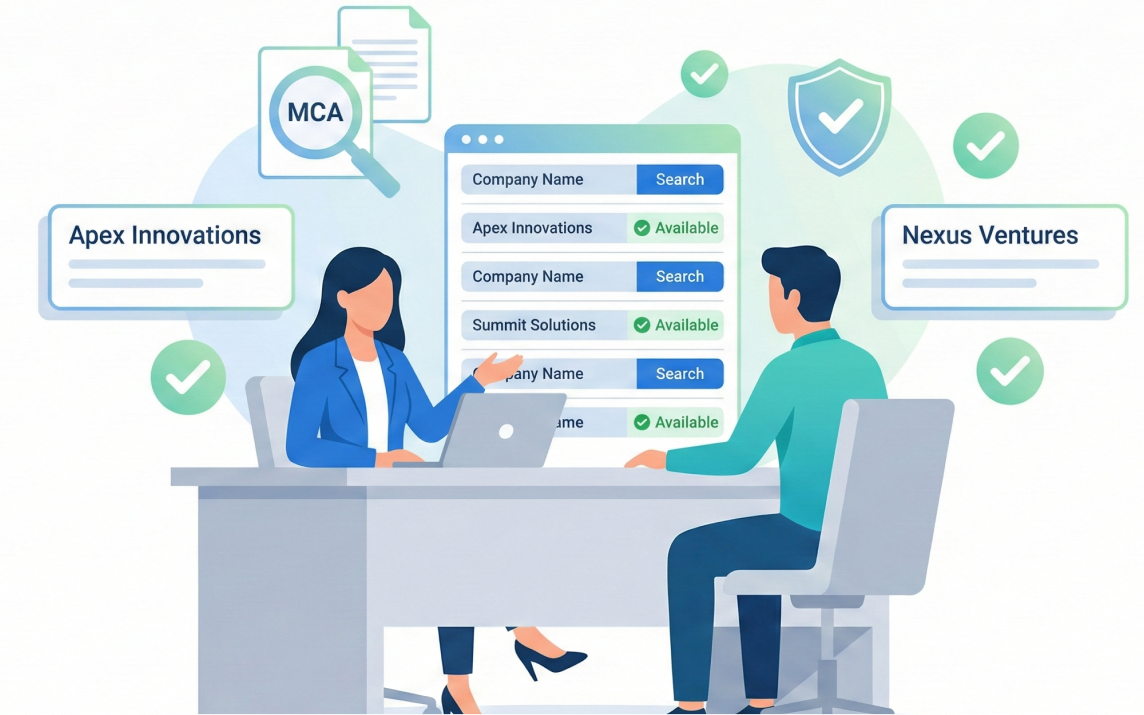
Name Reservation

Name Reservation

We assist in selecting and reserving your company name with the Ministry of Corporate Affairs (MCA).

Document Preparation

Document Preparation

We collect and prepare all required documents such as ID proofs, address proofs, and Digital Signature Certificate (DSC).

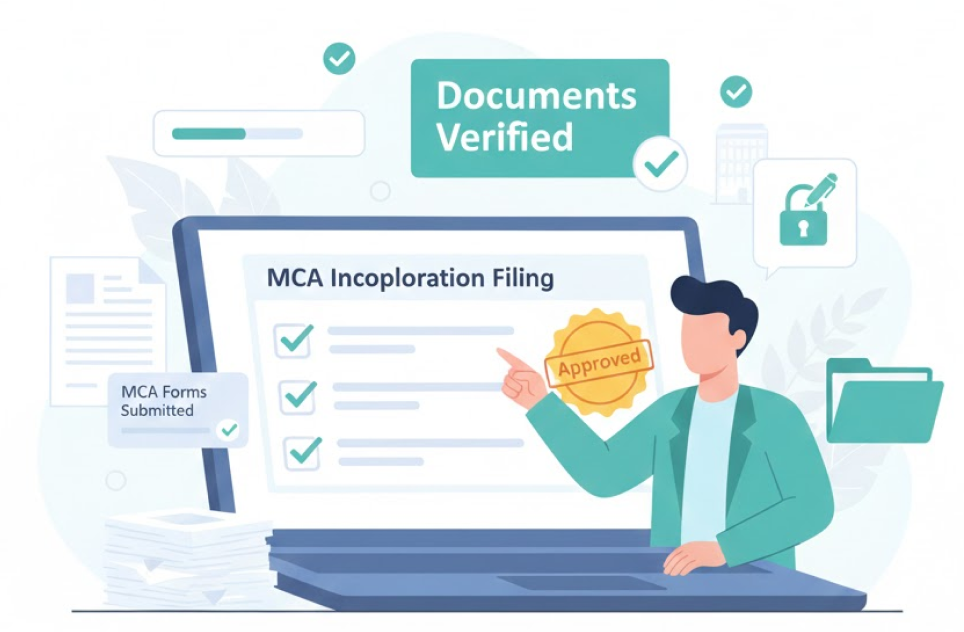
Filing with MCA

Filing with MCA

Our experts file all the incorporation forms and documents with the MCA online.

Certificate of Incorporation

Certificate of Incorporation

Once approved, you receive your Certificate of Incorporation along with PAN, TAN, and other registration details.

Post-Incorporation Support

Post-Incorporation Support

We also help with GST registration, opening a current bank account, and compliance setup.

Which Company Type is Right for You?

Choosing the right type of company is an important step in your business journey. Each structure has its own advantages based on your goals, business size, and future plans.

PointsPrivate Limited CompanyOne Person Company (OPC)Limited Liability Partnership (LLP)Partnership FirmProprietorship Firm
Applicable LawCompanies Act, 2013Companies Act, 2013LLP Act, 2008Partnership Act, 1932No specific law (local rules apply)
RegistrationMust register with ROC (Registrar of Companies)Must register with ROCMust register with ROCCan register under State lawNot mandatory, but can register locally
Number of OwnersMinimum 2 and up to 200 peopleOnly 1 owner and 1 nomineeMinimum 2 people, no maximum limitMinimum 2 and up to 20 peopleOnly 1 owner
Separate Legal IdentityYes, it has its own legal identityYesYesNoNo
Liability ProtectionOwners’ risk is limited to their shareOwner’s risk is limitedPartners’ risk is limitedPartners have full personal riskOwner has full personal risk
Statutory AuditCompulsory every yearCompulsory every yearNeeded only if turnover crosses limitNot compulsoryNot compulsory
Ownership TransferEasy to transfer sharesNot transferableNeeds consent from other partnersNot easyNot possible
Perpetual ExistenceContinues even if owners changeContinues after owner’s death (nominee takes over)Continues as a separate firmEnds if a partner leaves or diesEnds if owner stops or dies
Foreign OwnershipAllowed under rulesNot allowedAllowed under rulesNot allowedNot allowed
TaxationCompany tax rateCompany tax ratePartnership tax ratePartnership tax ratePersonal income tax rate
Compliance WorkHigh – yearly reports & filingsMedium – some yearly reportsMedium – few yearly formsLow – simple filingsVery low – basic tax filing
Private Limited Company

Private Limited Company

StartupsGrowing businessesFundraising companies

Regulated under: Companies Act, 2013

A Private Limited Company (Pvt Ltd) is a popular business structure in India. It gives your company a separate legal identity and protects your personal assets from business risks. Requires at least 2 shareholders and 2 directors with a maximum of 200 members; shares cannot be publicly traded. Needs DIN and DSC for directors' MoA/AoA.

Limited Liability Partnership (LLP)

Limited Liability Partnership (LLP)

ProfessionalsSmall businessesService-based Firms

Regulated under: LLP Act, 2008

A Limited Liability Partnership (LLP) combines benefits of partnership and company. It’s simple to manage, has low compliance, has no minimum capital requirement, and offers limited liability protection to partners. Minimum 2 partners (no maximum limit) and 2 designated partners, one resident in India. Needs DSC, proofs, and designated partner IDs.

One Person Company (OPC)

One Person Company (OPC)

Solo entrepreneurs

Regulated under: Companies Act, 2013

A One Person Company (OPC) allows a single individual to form a company in India, acting as both sole shareholder and director. It provides limited liability, separate legal identity, and complete control to one owner. Requires one member (Indian citizen/resident) and one director (up to 15) with a mandatory nominee for succession. Needs to file the SPICe+ form with MCA, including DIN/DSC, MoA/AoA, nominee details, and proofs.

Choose business structure
Partnership Firm

Partnership Firm

Small traditional businessesFamily-run setups

Regulated under: Indian Partnership Act, 1932

A Partnership Firm involves two or more individuals agreeing to share profits and responsibilities of business. It's not a separate legal entity, so partners have unlimited liability for debts. Minimum 2 partners (maximum 20 for general business, 10 for banking). Draft a notarized partnership deed, and file Form A with the register of firms (state-level) and ID/address proof.

Public Limited Company

Public Limited Company

Large businessesPublic investment

Regulated under: Companies Act, 2013

A Public Limited Company (PLC) is a business structure in India that offers shares to the general public via stock exchange. It functions as a separate legal entity with unlimited shareholders and stricter regulation for transparency. Required minimum 7 shareholders (no upper limit) and 3 directors. Needs to file SPICe+ form with MCA, including DIN/DSC for director, MoA/AoA, and minimum 5 lakh paid-up capital (varies).

Understanding the Acts Behind Company Registration

When you register a company, it's important to know the laws that protect your rights and guide your business operations.When you choose our Company Registration Service, we handle all legal filings and ensure your business is registered as per the correct Act so you can focus on growth, not paperwork.

Companies Act, 2013

Companies Act, 2013

Limited Liability Partnership Act, 2008

Limited Liability Partnership Act, 2008

Indian Partnership Act, 1932

Indian Partnership Act, 1932

Income Tax Act, 1961

Income Tax Act, 1961

Goods and Services Tax (GST) Act, 2017

Goods and Services Tax (GST) Act, 2017

We handle all Legal Filings

From name approval to final certification

Company registration in India is regulated by several key Acts and Government bodies that ensure transparency, accountability, and legal recognition. Each type of business entity is governed by specific Acts that ensure your company is legally valid and compliant.


Eligibility Criteria for Company Registration in India

1. Minimum Number of Directors and Shareholders

Private Limited Company

Minimum 2 Directors and 2 Shareholders are required.

Public Limited Company

Minimum 3 Directors and 7 Shareholders are required.

One Person Company

Only 1 Director and 1 Nominee are needed.

LLP

Minimum 2 Partners are required.

2. Residency Requirement

At least one director of the company must be an Indian resident. A person who has stayed in India for at least 182 days during the previous financial year.

3. Unique Company Name

The company name must be unique and not identical or similar to any existing company or trademark. The name should follow guidelines set by the Ministry of Corporate Affairs (MCA).

4. Foreign nationals permitted

Foreign nationals and non-residents can act as directors or shareholders by providing notarized and apostilled proofs of identity and address such as passport and utility bills.

5. Valid documentation

Indian applications need valid documents like PAN, Aadhaar and recent address proof (utility bill or bank statement, not older than 60 days)

6. DIN and DSC required

Every individual who wants to become a company director must have a Director Identification Number (DIN) and a Digital Signature Certificate (DSC) for e-forms and signing company documents

7. Age and legal capacity

Directors and shareholders need to be at least 8 years old and legally capable of signing contracts.

Documents and Requriments

Before you start the registration process, make sure you have all the necessary documents and details ready. Here's a simple checklist that will help you prepare efficiently.

Personal Documents of Directors and Shareholders

  • PAN Card of all directors and shareholders (mandatory for Indian nationals)
  • Passport (for foreign nationals or NRIs)
  • Aadhaar Card / Voter ID / Driving License as identity proof
  • Latest utility bill (electricity, telephone, or gas bill) as address proof
  • Passport-size photographs of all directors and shareholders

Registered Office Address Proof

  • Recent utility bill (electricity, water, or property tax receipt) — not older than 2 months
  • Rent agreement or lease deed (if the office premises are rented)
  • NOC (No Objection Certificate) from the property owner to use the address as the registered office

Company Name

  • Select at least two unique names for approval
  • Ensure that the name complies with MCA naming guidelines and is not similar to any existing trademark or company name

Digital Requirements

  • Digital Signature Certificates (DSC) for all directors
  • Director Identification Number (DIN) for all proposed directors

Capital and Shareholding Details

  • Decide the authorized capital and paid-up capital
  • Define the shareholding ratio among the shareholders

Company Documents to Be Prepared

  • Memorandum of Association (MOA) – outlines the company’s objectives
  • Articles of Association (AOA) – defines rules and regulations for company management
  • Declaration and Consent Forms – to be signed by directors and shareholders

Our Complete Solutions

We handle everything under one roof, including registrations, filings and compliance. Our experienced professional team provides end-to-end support at every stage with simple process to keep your business operations smooth and fully compliant. With years of industry expertise, we deliver customized solutions for startups as well as established enterprises.

100% Online & Hassle-Free Process

Team of Experienced Professionals

Technology-Driven Process

Dedicated Customer Support

Transparent & Affordable Pricing

Perfection and Trust

FAQ

Frequently Asked Questions

Company registration is the legal process of forming a new company under the Companies Act, 2013. It gives your business a separate legal identity, so you can legally open a bank account, own assets, and entre into contracts. It also enhances credibility, protects your brand name, and helps attract investors.