Micro, Small and Medium Enterprises (MSMEs) are the backbone of India’s economy. They create employment, support local industries and contribute significantly to economic growth. But with this much importance, many MSMEs struggles to find consistent and reliable business opportunities because most small businesses rely on local networks, private contracts or intermediaries to get work. Also many MSMEs find is difficult to approach government departments because traditional procurement processes used to be complex and too much paperwork.
To solve this problem Government of India introduced Government e-Marketplace (GeM). This digital platform allows government departments, ministries and public sector organizations to purchase goods and services directly from registered vendors. But many businesses register on GeM and face difficulties in participating in tenders or listing the right services and most common reason is something that many businesses overlook is their NIC code.
Your NIC code can act like “golden ticket” that determines whether your business qualifies for certain government tenders. Let’s understand how this small but powerful classification can help MSMEs unlock more opportunities on GeM and increase their chances of winning government contracts.
Understanding National Industrial Classification (NIC Code)
The government of India use this National Industrial Classification (NIC) system to classify and categorize different business activities. There is a national industrial classification code for every type of business activity, such as manufacturing, consulting, trading, or providing services.
The NIC system is developed and maintained by Ministry of Statistics and Programme Implementation. The purpose of this classification system is to organize economic activities and make it easier for government departments to identify industries and sectors.
A NIC code is usually five-digit number that stands for a certain business activity. These codes help government authorities understand what kind of work business performs.
For example:
- A consulting firm will have different NIC code than a manufacturing company.
- A construction contractor and an IT services company are not in the same group.
These codes are important for government platforms and compliance systems to put businesses in the right groups.
The NIC classification system is commonly used for:
- Company registration
- MSME or Udyam registration
- Government procurement systems
- Economic data analysis
- Compliance and regulatory documentation
Structure of NIC Codes
The National Industrial Classification (NIC) system puts business activities into groups in a structured way. Each NIC code has different levels, with the broadest level being the industry sector and the narrowest level being the business activity. This structure helps government systems correctly identify and sort businesses.
NIC codes follow a hierarchical structure:
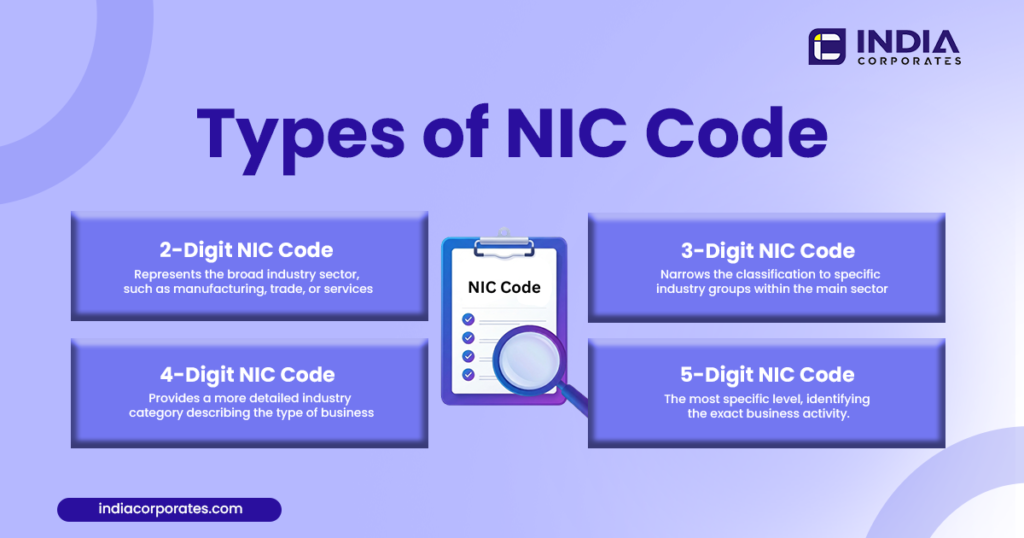
- 2-digit code – Broad industry category
- 3-digit code – Sub-sector
- 4-digit code – Industry group
- 5-digit code – Specific business activity
Where NIC Codes Are Used
- Business Registration – Companies and LLPs use NIC codes during incorporation to define their business activities.
- MSME / Udyam Registration – NIC codes help classify MSMEs based on the type of industry they operate in.
- Government Tenders and GeM – Procurement platforms use NIC codes to categorize vendors according to their services or products.
- Statistical and Economic Analysis – Government departments use the national industrial classification system to analyze industry data and industry trends.
- Regulatory and Compliance Filings – Certain registrations and compliance filings require businesses to declare their NIC classification.
What is GeM
The Government e‑Marketplace (GeM) is an online procurement portal created by the Government of India to simplify the process of government purchasing.
Before GeM, government procurement had lengthy procedures and manual paperwork. GeM digitalized this process and created transparent marketplace where registered vendors can sell goods and services to government buyers.
Government organizations use GeM to purchase a wide range of items, including:
- Office supplies
- IT equipment
- Furniture
- Vehicles
- Professional services
- Manpower services
- Maintenance services
- Security services
Benefits of Government e‑Marketplace GeM
Access to Government Buyers: Through GeM, businesses can sell to ministries, departments, and public sector organizations across India.
Transparent Procurement: The platform follows digital processes that reduce manual intervention and increase transparency.
Equal Opportunity: Small businesses can compete with larger companies because the system follows standardized rules.
Nationwide Market: A vendor registered on GeM can receive orders from anywhere in the country.
Why NIC Code important for GeM Tender Eligibility
The system classifies vendors according to their registered business activities when companies register on the Government e-Marketplace (GeM) platform. The NIC code is frequently used in this classification. When looking for vendors, government purchasers typically filter suppliers according to industry categories. Your company might not show up in the relevant vendor pool if your national industrial classification code does not match the necessary category. This inaccurate classification may reduce your visibility even if your business is able to provide a good or service.
Here’s how NIC code affects GeM tender eligibility:
- Decides in which category your company will be listed.
- Helps procurement systems in matching vendors with the specifications of tenders
- Enables customers to filter suppliers according to industry expertise
- Increases the legitimacy and lucidity of business operations
Role of NIC Code in MSME and Udyam Registration
The NIC code is also an important component for MSME or Udyam registration. Businesses must declare type of economic activity during registration. The National Industrial Classification System helps authorities of businesses.
The selected NIC code helps determine:
- The industry sector of the business
- Eligibility for certain government schemes
- Data classification for economic reporting
- Access to industry-specific opportunities
This classification becomes more relevant for those who are participating in government procurement. A correctly selected national industrial classification code ensures that the business profile reflects the actual nature of work performed by the company. This helps procurement platforms, government departments, and financial institutions understand the company’s operational area. Businesses that select incorrect or unrelated categories during registration may face issues later when applying for tenders or compliance processes.
Common Mistakes Businesses Make While Choosing NIC Code
Most businesses think the NIC code is a normal formality during registration, and they select codes that do not accurately match their business activities.
Choosing very general category: Businesses sometimes select broad classification instead of the specific activity they perform.
Selecting a code unrelated to their main business: Sometimes businesses select a code that sounds similar but falls under different industry category.
Copying another company’s classification: Some startups copy competitors’ NIC codes without verifying if they matches to their own services.
Not updating the code after business expansion: When companies add new services or products, they might forget to change their classification.
These mistakes can make it harder for businesses to be seen on procurement platforms and limit their access to some opportunities.
Example: How NIC Code Impacts Tender Participation
A startup providing digital marketing services wants to participate in government tenders for digital communication campaigns. but, during business registration, company selected an NIC code related to IT software development instead of marketing services. When government department searches for vendors offering marketing or communication services on GeM, the startup may not appear in the relevant category. As a result, company might miss tender opportunities even though it has expertise to handle such projects. Selecting the correct NIC code ensures that businesses are categorized properly and can be discovered for relevant procurement opportunities.
How to Find the Right NIC Code for Your Business
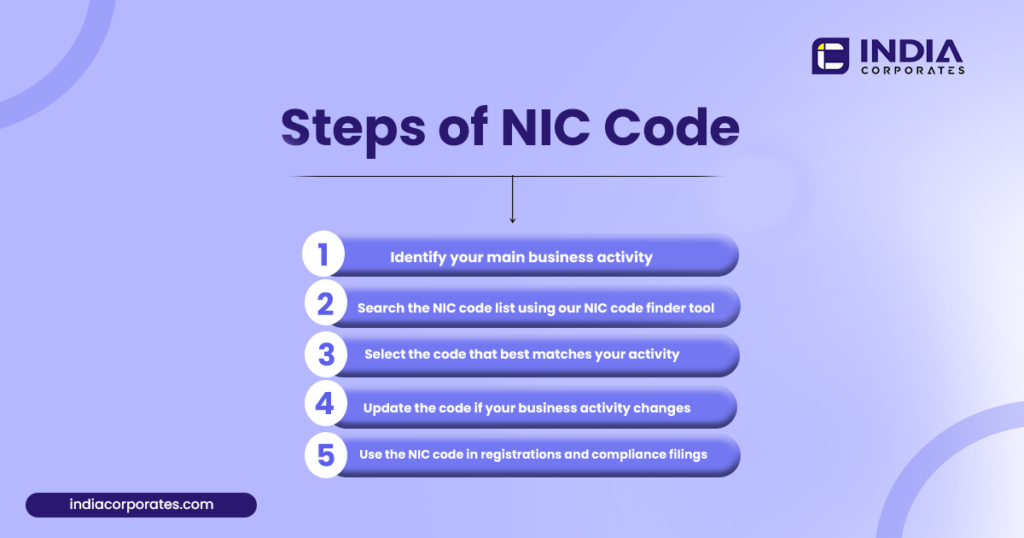
Choosing correct national industrial classification code requires understanding the primary activity of your business. Businesses can follow few simple steps:
- Identify the main business activity performed by the company
- Check the broader industry category under the NIC classification
- Narrow down to the most accurate 5-digit classification
- Verify that description matches your business operations
To make this process easier, businesses can use online search tools that provide full NIC code list. The NIC code search tool available on IndiaCorporates helps businesses quickly find appropriate classification based on their activity.
Explore the tool here:
https://indiacorporates.com/tools/nic-code
NIC Code vs HSN/SAC Code
Businesses sometimes confuse NIC codes with HSN or SAC codes, but these classifications serve different purposes. The NIC code is used to classify the type of business activity or industry sector. It helps identify what kind of work company performs. And, HSN and SAC codes are used in GST system to classify goods and services for taxation purposes.
In simple terms:
- NIC Code → Business activity classification
- HSN Code → Classification of goods for GST
- SAC Code → Classification of services for GST
Understanding the difference between these systems helps businesses manage both compliance and procurement eligibility more effectively. Businesses can also explore detailed information about HSN and SAC classification systems here: https://invocreto.com/blog/hsn-code-classification-mistakes-gst-notices/
Conclusion
For businesses looking to participate in government procurement, NIC code plays more important role than many people realize. It helps government systems identify industry sector of company and match vendors with relevant procurement opportunities. Platforms such as Government e-Marketplace (GeM) depend on accurate business classification to organize vendor databases and make the procurement process smoother and more efficient.
Choosing correct National Industrial Classification (NIC) code make sure that your business is properly categorized and can appear in appropriate industry segments. This is especially important for startups, MSMEs, and growing businesses that want to expand through government tenders. For micro, small, and medium enterprises (MSMEs), right NIC code can also help in accessing government schemes, procurement preferences, and financial support programs designed to promote small business growth.
Taking a few extra minutes to verify and select the correct NIC code during registration can make big difference in future opportunities. It helps businesses stay compliant, improve visibility on procurement platforms, and connect with right government buyers.
FAQ’s
An NIC code is a numerical classification used in the National Industrial Classification system to categorize different types of business activities and industries in India.
NIC code helps government procurement platforms categorize vendors according to their business activity, making it easier to match suppliers with relevant tenders.
A standard NIC classification typically uses a five-digit code to identify a specific business activity within an industry sector.
Yes, businesses can select multiple NIC codes if they are involved in more than one type of activity.
Businesses can search the complete NIC code list using online tools such as the NIC code finder available on IndiaCorporates website.

No comments yet