
The financial year starting from 1 April 2026 brings fresh cycle of changes, adjustments and planning for MSMEs. The first month is usually focused on setting up system, updating records and aligning operations with new budgets, pricing structures and compliance requirements.
By May, MSMEs start gaining clearer visibility of their actual business performance, including early sales data, purchase patterns, vendor payment cycles and GST filing trends under new financial year structure. This is right time to use structured GST compliance check to identify gaps and correct mistakes early.
Your 6-point GST compliance checklist
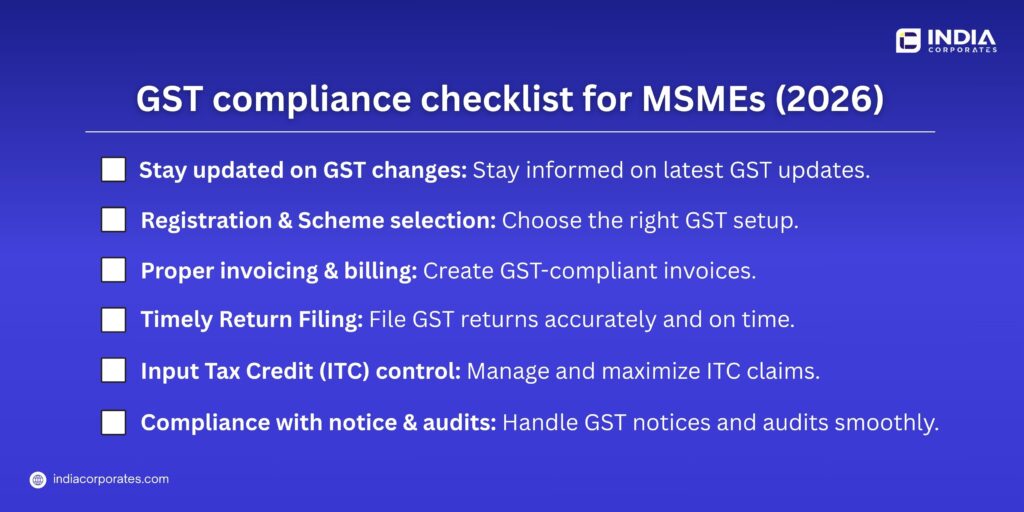
1. Stay updated on GST changes
From 1 April 2026 GST rules have come into effect. These changes mainly focus on better tracking, stricter compliance and more digital processes for e-invoicing, and now businesses with turnover above 5 crore have stricter timelines for reporting invoices and more rules.
What to do:
- Check for GST updates at least once a week so you don’t miss any important changes
- Follow IndiaCorporates for government announcements and accurate information
- Choose accounting or billing software that is regularly updated with GST rule changes
- Review your business processes and make sure they follow new rules
2. Registration & Scheme selection
Choosing wrong GST registration type or scheme can cost your business both money and time. Many MSMEs register under regular GST scheme by default and continue paying full tax rates and filing monthly returns even when simpler, cheaper option is available to them. Composition scheme is one of most underused tools for small businesses.
What to do:
- Check your current annual turnover if you are below composition threshold
- If you sell mostly to end customers (B2C), composition scheme is usually better choice
- Verify your GST registration details: business address, nature of activity and HSN/SAC codes must all be current.
- If you have multiple business locations or branches, confirm each one is correctly registered.
- Review your PAN linkage, Aadhaar authentication and bank account details on GST portal
3. Proper invoicing & billing
GST invoice is not just payment request, it is legal document. Errors in invoicing are the main reasons MSMEs face GST notices, rejected ITC claims and failed e-way bills. If your invoices do not have right format, right HSN code or correct tax breakdown, it can create problems for both you and your buyer.
- Check that every invoice includes GSTIN, invoice number, date, HSN/SAC code, tax rate and place of supply
- Verify whether your turnover crosses ₹5 crore, if yes e-invoices is mandatory for all B2B sales
- Use accounting software that auto-generates GST-compliant invoices to avoid manual errors
- For goods movement above ₹50,000 in value, make e-way bill must be generated before dispatch
Quick tip: You can also use simple online tools like https://invocreto.com/ to create GST-ready invoices quickly and avoid common errors.
4. Timely Return Filing
Late GST return filings are one of the most common and most avoidable reasons small businesses lose money. Late fee is 50 per day (20 per day for nil returns) and unpaid tax attract 18% annual interest. If you file GSTr-1 late your buyers cannot see your invoices in their GSTR-2B. This means they lose ITC on purchases from you which makes you less reliable supplier.
- Set calendar reminders for 11th (GSTR-1), 13th (GSTR-2B) and 20th (GSTR-3B) of every month
- Reconcile GSTR-1 and GSTR-3B before filing to avoid mistaches that trigger notice later
- Clear all pending returns from previous months, analyse late fees and interest can be settled under GST amnesty schemes when available
- Keep your Digital Signature Certificate (DSC) updated so filing is never blocked by authentication issues
- GST filings can be overwhelming. It’s better option to get professional help of indiacorporates for return filings to avoid errors and manual efforts every month
5. Input Tax Credit (ITC) control
Input Tax Credit is single biggest financial benefit of GST offers to registered businesses but most mismanaged area for MSMEs. If you do it right way, ITC reduces your actual tax outflow significantly and if done wrong it triggers demands, penalties and blocked credits that can disturb your cash flow.
Under GST 2.0, ITC matching is now automated. System checks whether ITC you claim in GSTR-3B matches invoices your suppliers have uploaded in their GSTR-1. Any mismatch is flagged instantly. If your supplier has not filed their return, your ITC gets blocked even if you have invoice and payment proof.
What to do:
- Claim ITC only on invoices that appear in your GSTR-2B, this is golden rule of ITC in 2026
- Follow up with suppliers who have not filed returns
- Remove blocked ITC items from your claims: personal expenses, food and beverages, club memberships and non-business costs
- Reconcile your purchase register with GSTR-2B every month before filing GSTR-3B
Note: wrongly claimed ITC must be reversed with interest at 24% per annum much higher than standard 18%. Always verify before claiming.
6. Compliance with notice & audits
GST department sends notices to many business owners for different reasons like mismatches in returns, late filing, ITC discrepancies and etc. Business owners should quickly and correctly respond. Unanswered notices can include penalties up to 100% of tax amount.
Instead of sending incorrect or incomplete reply, you can use our GST compliance and notice service. We help you prepare clear and legally correct response that is more likely to be accepted by tax department. Our team will also submit reply on GST portal and keep track of case until issue is fully resolved.
| # | Action Area | Priority | Deadline |
|---|---|---|---|
| 1 | Stay updated on GST changes and new notifications | 🟠 High | Ongoing — monthly habit |
| 2 | Review GST registration and scheme selection | 🟡 Medium | By 31 May 2025 |
| 3 | Ensure all invoices are GST-compliant and e-invoicing ready | 🔴 Critical | Immediate — every invoice |
| 4 | File GSTR-1 and GSTR-3B on time, every month | 🔴 Critical | 11th and 20th each month |
| 5 | Audit and control ITC — claim only what is in GSTR-2B | 🔴 Critical | Before filing GSTR-3B |
| 6 | Respond to GST notices and audits on time | 🔴 Critical | Within notice deadline (15–30 days) |
What is GST 2.0 and why should MSMEs care?
GST 2.0 is not new law, it is simply next stage of GST updates with new GST rules in India. Now there is more use of automation and technology. GST system now checks data more closely and matches details between buyers and sellers in real time. For small business owners, this means mistake that were ignored earlier can now lead to automatic notices. Input Tax Credit (ITC) may get blocked if it does not match with your supplier’s data. Also any penalties or disputes can affect small businesses more as they may not have large teams to handle compliance.
There is no need to worry just stay prepared by following above simple checklist and keeping your records accurate with this having right support can make things much easier. Our team can help you manage your GST compliance, fix errors early and handle notices, all with proper guidance and simple processes in one place.
Common mistakes MSMEs make with GST every year
1. Filing late and paying interest: GSTR-3B has date of 20th of each month for monthly filers. Missing this cost 18% annual interest on unpaid tax
2. Claiming ITC on blocked expenses: GST paid on club membership, personal travel, food and beverages for employees and gifts cannot be claimed as ITC. Many businesses claim it by mistake which leads to notices months or years later.
3. Not tracking reverse charge mechanism ( RCM): if you buy services from unregistered vendor a freelancer, or a transport service you may owe GST under RCM as buyer.
4. Mixing personal and business expenses: this is both GST issue and income tax issue. It makes reconciliation impossible and increases audit risk.
5. Not maintaining digital invoices: under e-invoicing rules now applicable to businesses with a turnover of above ₹ 5 crore.
Government schemes that every MSMEs should use in 2026
MSME Samadhaan: digital portal to file complaints against delayed payments from large buyers. If large company owes you money for more than 45 days, you can file Micro and Small Enterprises Facilitation Council (MSEFC) will purse recovery.
TReDS platform: trade receivables discounting System lets you sell your unpaid invoices to financiers at small discount and get cash immediately. It is particularly useful when large corporations delay payments for 60 to 990 days.
CGTMSE: Credit Guarantee Fund Scheme for Micro and Small Enterprises covers loans up to 5 crore without collateral. If you need working capital loan but have no assets to pledge this is your option
Udyam registration: This free registration opens door to all government MSME benefits. Lower GST rates on some services, priority lending, and government tender eligibility and more.
Final thoughts
Running small business in India in 2025 means handling more automated tax system while also managing daily operations, team payment and growth. System changes (GST 2.0) are not problem, but ignoring it can lead to loss of time and money.
Six steps in this GST compliance checklist, reconciling your returns, checking your ITC, planning your cash flow, reviewing your GST setup and keeping track of everything are more important. Taking action at right time matters more (preferably before end of May). This is where we can help. Our team supports you with GST reconciliation, return filing and overall GST compliance management. We also help you identify risks early, fix errors and handle GST notices if they arise. With right support, you can stay compliant without spending too much time on it.
Stay compliant, avoid stress and focus on growing your business while we take care of your GST

2 comments
This is a very practical and well-organized GST compliance checklist for MSMEs. Staying on top of return filings, invoice management, and input tax credit can save businesses from unnecessary penalties and compliance issues. Articles like this make complex tax requirements much easier to understand. Thanks for sharing such useful guidance!
A valuable resource for MSMEs aiming to manage their GST responsibilities efficiently. Keeping invoices organized, filing returns on time, reconciling records, and tracking tax payments can help businesses avoid common compliance errors. A well-prepared checklist makes GST management easier and supports smooth business operations.