
One of most important budgets of recent years the Union Budget 2026-27 is presented by Finance Minister Nirmala Sitharaman on February 1, 2026. The Government has described it as blueprint for building developed India, also called Viksit Bharat 2047. The year 2047 is important because it will mark 100 years of India’s Independence.
This budget is not focused on short-term announcements or quick benefits but it focuses on long-term planning, strong foundations and steady progress. The budget is based on three main duties (Kartavys) that guide all policies and decisions:
- Sustaining economic growth, so that India keeps growing year after year.
- Building capacity, which means creating factories, infrastructure, skills, and technology.
- Ensuring inclusive development, also known as Sabka Saath, Sabka Vikas in which growth benefits are for everyone.
Let’s explore and understand Union Budget 2026-27 step by step, covering economic goals, major schemes, tax changes and detailed critical analysis.
1. Economic background: balancing growth and control
The first and most important goal of budget is to keep India’s economy growing by controlling government borrowing. Government wants to spend enough money to build infrastructure and create jobs, but it also wants to avoid creating too much debt. And this balance is important because too much borrowing can lead to higher interest payments, pressure on future budgets, loss of investor confidence and at other hand, spending too little can slow down economy and reduce job creation.
Fiscal Deficit
The fiscal deficit is difference between how much money government earns and how much it spends in year. When spending is higher than income, government borrows money to fill gap. For 2026-27, government has set fiscal deficit target at 4.3% of GDP (in 2025-26, it was 4.4% of GDP). This small reduction shows that instead of cutting spending suddenly, government is slowly and carefully reducing its borrowing. This approach helps maintain economic stability.
GDP growth expectations
Gross Domestic Product (GDP) is standard measure of value added created through production of goods and services in country during certain period (quarter or year) which serves as the country’s economic health and performance. India surpassed Japan to become world fourth-largest economy by nominal GDP in 2025. The budget expects India’s economy to continue growing strongly in upcoming years
- Nominal GDP growth is projected (FY 2025-26 estimate): 357.14 lakh crore (10.5%).
- Real GDP growth is expected to (FY 2025-26 estimate): 7.4%
This growth is expected to come from Infrastructure development, Manufacturing expansion, Services sector growth, Technology and innovation.
Capital expenditure: investing in future
The strongest points of this budget is capital expenditure, also known as capex. Capital expenditure means spending money on acquiring, upgrading, or maintaining physical assets like property, buildings, technology or equipment that last for many years. For examples roads and highways, railways, ports and airpots, power plants, industrial parks.
In Union Budget 2026-27:
- Capital expenditure has increased by 9%
- Total capex is ₹12.2 lakh crore
- This is about 3.1% of India’s GDP
2. Major schemes and sector-wise focus
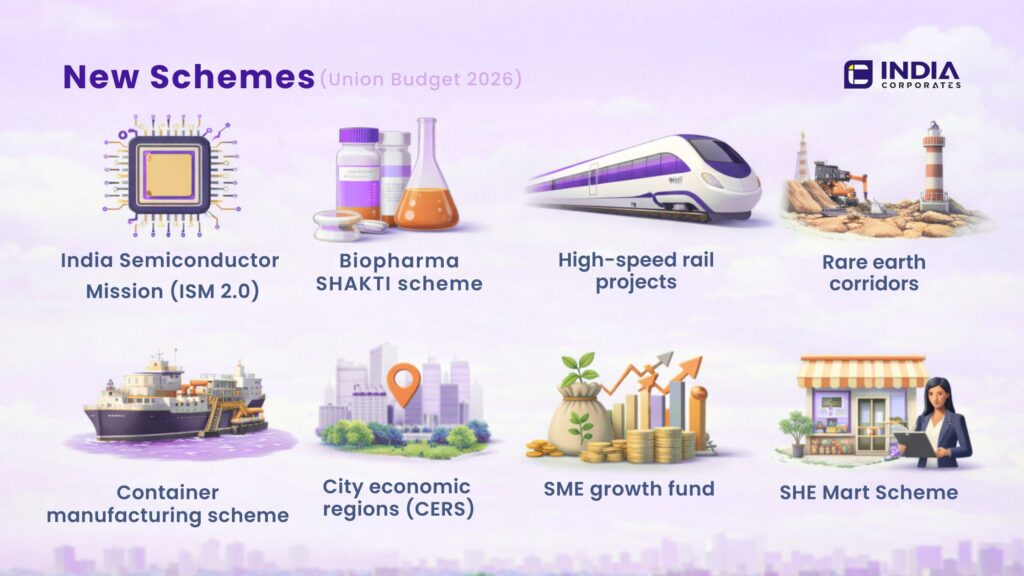
The budget gives special attention to strategic sectors. These are areas that are important for national security, long-term growth and global competitiveness.
A. Technology and Manufacturing
ISM 2.0: India Semiconductor Mission
Semiconductors are small chips that are used in almost everything today, such as smartphones, cars, computers, medical machines, and defence equipment. India currently imports most of its semiconductor needs.
The second phase of India Semiconductor Mission (ISM 2.0) focuses on:
- Making semiconductor equipment in India
- Producing raw materials used in chips
- Supporting Indian companies that design chips
Biopharma SHAKTI scheme
Biopharma means advanced medicines made using biological processes. The Biopharma SHAKTI schemes has budget of 10,000 crore and aims to make india global hub for advanced medicines. This scheme helps India move from basic medicine production to high–quality medical innovation.
Key features include:
- Setting up 3 new NIPER institutes
- Creating more than 1,000 clinical trial centres
- Supporting research in vaccines and advanced drugs
Rare earth corridors
Rare earth minerals like are very important for modern technologies like electric vehicles, solar panels, wind turbines, and electronics. The budget plans to develop rare earth corridors in Odisha, Kerala, Andhra Pradesh, and Tamil Nadu. These corridors will focus on mining, processing, research and manufacturing, leveraging mineral rich base of these states. This will help India secure important raw materials and support clean energy industries.
B. Infrastructure and Logistics
High-speed rail projects
The budget announces seven new high-speed rail corridors. These projects aim to reduce travel time, improve connectivity, and support regional economic growth. High-speed rail corridors:
- Mumbai-Pune (48 mins)
- Pune-Hyderabad (1hr 55 mins)
- Hyderabad-Bengaluru (2hrs)
- Hyderabad-Chennai (2 hrs 55 mins)
- Chennai-Bengaluru (1 hr 13 mins)
- Delhi-Varanasi (3 hr 50 mins)
- Varanasi-Siliguri (2 hrs 55 mins)
Coastal shipping and inland waterways
Currently only 6% of goods are transported through waterways. India’s infrastructure goal is to increase this share to 12% by 2047, which is 20 new national waterways to be operationalised over next five years. This helps to reduce transport costs, lower pollution, reduce pressure on roads and railways.
Container manufacturing scheme
India depends heavily on imported shipping containers. To solve this and support logistics and trade infrastructure, budget proposes scheme for Container Manufacturing, 10,000 crore has been allocated for five year period.
City economic regions (CERs)
The union budget focuses on developing Tier-2 and Tier-3 cities and temple towns into self-sustaining, integrated hubs. Budget allowed ₹5,000 crore per city and funding linked to urban reforms. This will help reduce pressure on large metropolitan cities and spread growth more evenly, create sustainable and economic zones.
C. MSMEs and employment
SME Growth Fund Scheme
SME growth fund is government support announced in budget to provide capital and growth support to high-potential small and medium enterprises (SEMs). 10,000 crore (approx USD 1.09 billion) SEM growth fund to provide equity backing, which helps SEMs become large and competitive companies. Also this scheme help SME scale operations, access risk capital and reduce dependence on traditional debt financing offering equity or equity-like support.
Corporate Mistras Scheme
Corporate Mistras is new support program for small and medium business MSMEs announced in Union Budget 2026-27 of India. Corporate Mitras will help small and medium businesses with understanding compliance rules, preparing basic financial reports, helping with tax and regulatory paperwork, telling business owners how to follow laws correctly so owners can focus on their business.
This support is expected to be more local and affordable, especially in smaller cities (Tier 2 and Tier 3)
SHE Mart Scheme
The SHE Mart is new marketplace platform designed to help women-led businesses grow and reach more customers. The name ‘SHE Mart’ is short for Self-Help Empowerment Mart, scheme that encourages women to become entrepreneurs and strengthens their presence in business.
SHE Mart will focus on women entrepreneurs who may face challenges such as lack of access to larger markets, technology and support. It benefits to women-run micro, small and medium enterprises (MSMEs), women self-help groups and cooperatives, women artisans who creates handmade or traditional goods.
- Online Marketplace: It is expected to act as an online marketplace (like Amazon or Flipkart), where women entrepreneurs can list and sell their products directly to customers.
- Training and Skill Development: The scheme will provide training programs to help women get familiar with digital tools, marketing strategies, and e-commerce.
- Financial Support: Women will have better access to loans and financial resources to run their businesses. The government may also offer subsidies to lower the costs of setting up their digital storefronts.
3. Tax changes explained in details
Income Tax Act 2025
From April 1, 2026 old Income Tax Act of 1961 will be replaced (which has been in place for decades). This act aims are:
- Simpler language and forms for ease of understanding
- Reduced paperwork and complexity in filing tax returns and compliances
- Fewer legal disputes through clearer rules and classifications
- Trust-based compliance regime to strengthen transparency and reduce friction
Personal Income Tax Slabs (new regime)
| Annual Taxable Income (₹) | Tax Rate |
| Up to ₹4,00,000 | 0% |
| ₹4,00,001 – ₹8,00,000 | 5% |
| ₹8,00,001 – ₹12,00,000 | 10% |
| ₹12,00,001 – ₹16,00,000 | 15% |
| ₹16,00,001 – ₹20,00,000 | 20% |
| ₹20,00,001 – ₹24,00,000 | 25% |
| Above ₹24,00,000 | 30% |
Note: Income up to ₹12 lakh is effectively tax-free under new regime for most taxpayers. After rebate, tax payable becomes zero if total income is below ₹12 lakh.
TCS relief under LRS (foreign payments)
Tax Collected at Source (TCS) is small amount collected by banks or intermediaries when you send money abroad under Liberalised Remittance Scheme (LRS). Budget 2026 has lowered these rates to benefit taxpayers.
TCS is not final tax, it’s collected upfront and adjusted when you file your return, but lower TCS means less cash blocked initially; this change helps students and families paying expenses abroad and travellers by reducing upfront costs.
New TCS rates:
- Education abroad: 2% (reduced from higher rates).
- Medical treatment abroad: 2%.
- Overseas tour packages: flat 2%.
More time to correct tax returns
If you make mistake or forget something, now you have 3 extra months to fix it
Earlier rule: Taxpayers could only revise their income tax return till 31 December of the assessment year.
New rule: You can now file revised or belated returns up to 31 March of the assessment year.
ITR filing deadlines
This schedule is to help taxpayers and accountants prepare returns carefully and avoid penalties.
- Individuals with simple returns (ITR-1, ITR-2): due by 31 july
- Non-audit businesses, professionals & trust (non-audit cases): due by 31 August
Corporate tax changes
Minimum Alternate Tax (MAT):
- MAT rate is now reduced from 15% to 14%.
- For companies not opting for the new concessional tax regime, MAT credit will be final meaning you cannot carry it forward to future years.
- If company opts into the new regime, it can carry forward MAT credit (up to 25% of tax liability each year) as long as original rules allow.
Indirect tax & customs duty reforms
Budget 2026 also changed some indirect taxes:
- Duty on personal imports (items brought in from abroad or bought online from foreign sellers) is reduced from 20% to 10% making many imported goods cheaper.
- 17 cancer drugs and medicines for rare diseases are fully exempt from basic customs duty, lowering costs for crucial treatments.
- Courier exports: the previous value cap per consignment was removed to boost e-commerce exports.
- Foreign cloud services: foreign companies providing cloud services using Indian data centres get a tax holiday until 2047, encouraging investment.
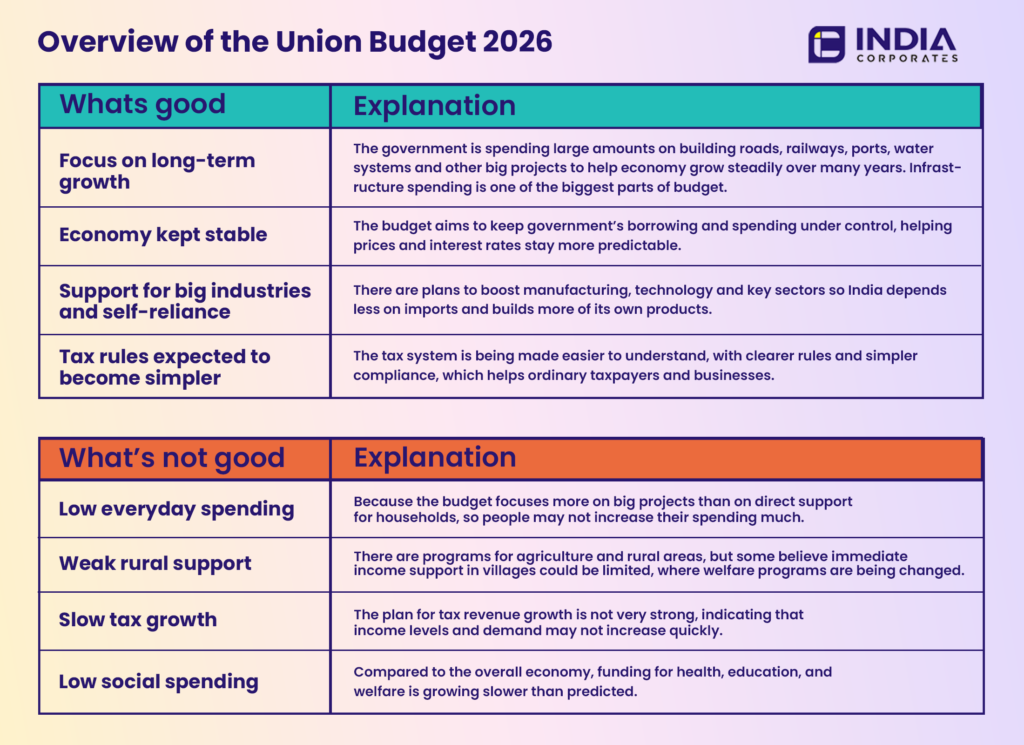
Overview of the Union Budget 2026
Final thoughts
Every year, people look at budget for tax changes, new schemes and government spending plans. This Union Budget 2026 is mainly focused on long-term growth and keeping economy stable. Budget puts lot of money into improving infrastructure, helping manufacturing industries and building stronger, competitive economy for future.
But there are few concerns: It doesn’t do enough to boost spending by regular people, which could slow down economy in short term. Rural areas and welfare schemes might not get support needed. The government is cautious about how much money it expects to collect in taxes, which might show slower economic growth.
Handling business registration, filings and legal requirements can be difficult while running your business, especially with new budget updates. That’s why IndiaCorporates provide full support, guiding you through each step from starting your business to filing your taxes and making sure everything is in order, with our help and timely updates you will stay on top of latest changes and avoid any compliance struggles.

No comments yet