
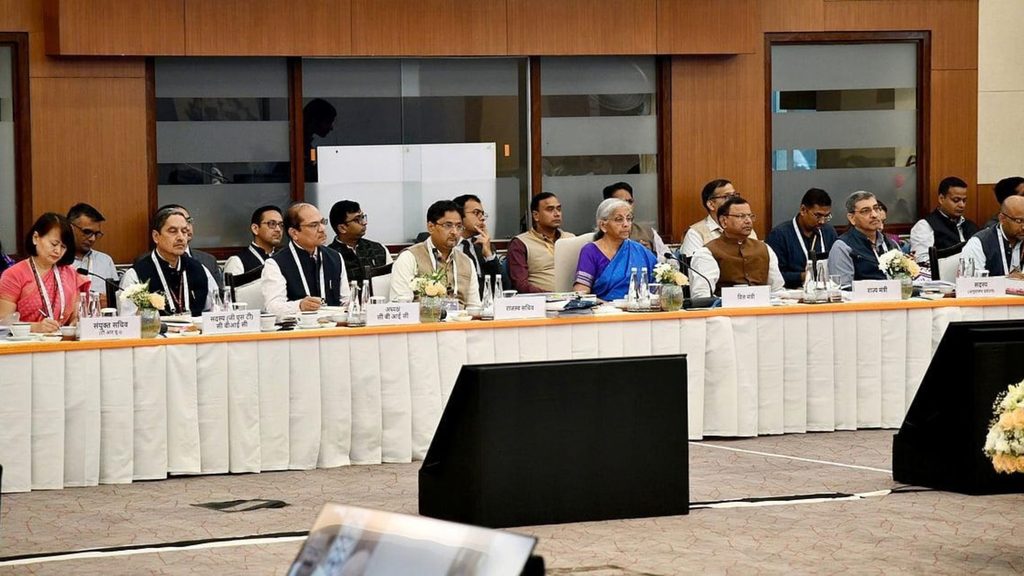
The 57th GST Council Meeting was held on 8 October 2026 in New Delhi, chaired by Union Finance and Corporate Affairs Minister Nirmala Sitharaman.
The GST Council Meeting focused on improving India’s Goods and Services Tax (GST) administration through simpler registration, faster refunds, wider input tax credit eligibility, reduced litigation and changes to enforcement provisions.
For business owners, MSMEs, manufacturers, exporters, traders and e-commerce sellers, these recommendations could affect GST registration, refund claims, return filing, tax disputes and the movement of goods.
Table of Contents
57th GST Council Meeting 2026: Key GST Updates
Here is a summary of the major decisions and recommendations announced in the GST Council Meeting on 8 October 2026.
| Area | Key Recommendation | Expected Impact |
| GST arrest powers | Recommend removing arrest provisions under Section 69 | Businesses and taxpayers facing GST enforcement proceedings |
| GST refunds | 90% provisional refund for eligible claims under a risk-based system | Exporters and eligible businesses with accumulated ITC |
| Input Tax Credit | Wider ITC eligibility and additional refund provisions | Manufacturers, exporters and other eligible taxpayers |
| GST registration | Simplified registration and amendments | Businesses and online sellers |
| GST returns | Lower general penalty and revised dispute provisions | Businesses facing GST notices or penalties |
| Penalties and appeals | Lower general penalty and revised dispute provisions | Businesses facing GST notices or penalties |
| E-way bills | More restricted, intelligence-based interception of goods | Traders, manufacturers and transporters |
| Small taxpayers | Proposed late-fee relief and an optional ARQP scheme | Eligible small businesses |
1. GST Arrest Powers: Council Recommends Their Removal
One of the major recommendations from the 57th GST Council Meeting concerns arrest powers under GST. The Council recommended removing Section 69 of the CGST Act, 2017, which provides for arrest in specified GST offences. It also recommended raising the monetary threshold for prosecution from ₹1 crore to ₹5 crore.
Key recommendations
- Removal of arrest powers: Omit Section 69 of the CGST Act, 2017.
- Higher prosecution threshold: Increase the threshold from ₹1 crore to ₹5 crore.
- Changes to offences and punishments: Rationalise certain prosecution provisions and the punishments prescribed under Section 132.
Business impact: These recommendations could reduce the risk of criminal proceedings in certain GST cases and provide greater clarity for businesses dealing with tax disputes. Businesses must continue complying with GST requirements, and the proposed changes should not be treated as effective until the necessary legal amendments come into force.
2. GST Refunds: Faster Processing and 90% Provisional Refunds
One of the key recommendations concerns faster GST refund processing, which can help eligible businesses manage their working capital more efficiently. The GST Council Meeting recommended the following changes:
- 90% provisional refund: For eligible refund claims relating to zero-rated supplies and inverted duty structure, 90% of the claimed amount would be sanctioned provisionally through a system-based process, based on risk evaluation.
- Faster acknowledgement: The proposed time limit for issuing an acknowledgement or deficiency memo would be reduced from 15 days to 10 days.
- Automatic cash ledger refunds: Refunds of excess balances in the electronic cash ledger would be processed automatically, without officer intervention.
How does this help businesses?
Exporters and eligible businesses with accumulated ITC may benefit from quicker access to funds. Faster refunds can reduce the amount of working capital tied up in the GST system. The 90% provisional refund mechanism is subject to the proposed conditions and system-based risk assessment; it should not be treated as an unconditional refund guarantee.
3. Input Tax Credit: Wider Eligibility and Refund Relief
Input Tax Credit allows eligible businesses to offset GST paid on qualifying purchases against their GST liability. Restrictions on ITC can increase costs and lock up working capital. The Council recommended changes to blocked ITC provisions and refunds of accumulated ITC in specified cases.
Proposed changes to blocked ITC
The Council recommended removing certain restrictions on ITC under Section 17(5) of the CGST Act for specified expenses and supplies, including:
- Outdoor catering
- Health and life insurance
- Telecommunication towers
- Pipelines laid outside factory premises
- Free samples
- Goods destroyed or written off due to expiry of shelf life, as required by law
These proposals are subject to the applicable conditions and legislative amendments. Businesses should not assume that every expense in these categories will automatically qualify for ITC.
Refund of accumulated ITC
The Council also recommended allowing refunds of accumulated ITC on capital goods in specified zero-rated supply cases and on input services and capital goods in specified inverted duty structure cases. The proposed timelines include:
- Input services under inverted duty structure: ITC availed on or after 1 November 2026.
- Capital goods: ITC availed on or after 1 April 2027, with refunds spread over 60 months.
How does this help businesses?
Manufacturers, exporters and businesses facing an inverted duty structure could benefit from reduced credit blockage and improved cash flow, subject to the final rules and eligibility requirements.
4. GST Registration: Easier Compliance for Small Businesses and Online Sellers
The GST Council Meeting recommended simplifying registration-related procedures to reduce delays and unnecessary interaction with tax officers.
Simplified registration amendments: The Council recommended automatic acceptance of amendments to most GST registration details, subject to the proposed rules. For taxpayers registered under the specified automatic-registration route, the proposal also covers changes to the principal place of business.
Small e-commerce sellers can expand across states: A proposed new Rule 14B would allow eligible small suppliers of goods selling through e-commerce operators to obtain simplified GST registration in states or Union Territories where they do not have a physical presence.
Under the proposal, eligible sellers could declare an e-commerce operator’s warehouse in that state or Union Territory as their principal place of business. The proposal includes a limit of ₹2.5 lakh per month on ITC passed on, excluding stock transfers between distinct persons, along with other prescribed conditions.
Example: A small seller based in Maharashtra may be able to sell goods through an e-commerce platform using its warehouse in another state without establishing a separate physical business location there, if the seller meets the proposed eligibility conditions.
How does this help businesses?
These measures could make registration amendments easier and help eligible online sellers expand their market without setting up a physical establishment in every state.
5. GST Returns: Better Reconciliation and Fewer Mismatches
Differences between GST returns and ITC records can lead to notices, additional compliance work and disputes. The Council recommended changes intended to improve reporting and reconciliation.
The key recommendations include:
- Improve GSTR-1, GSTR-1A and the Invoice Furnishing Facility (IFF) to support reconciliation with GSTR-3B.
- Introduce an electronic statement for reporting tax paid under the Reverse Charge Mechanism (RCM) and ITC claimed.
- Introduce an Electronic Credit Reversal and Reclaim Statement to improve reporting of ITC reversed and reclaimed.
- Improve the Invoice Management System (IMS), including facilities for recipients to accept, reject or keep certain inward-supply documents pending, subject to conditions.
- Provide mechanisms to correct specified mismatches between reported tax liability and ITC.
The Council recommended that the proposed alternative mechanism for correcting liability and ITC reporting could come into force from the April 2027 return period, subject to consultation and the necessary legal changes.
How does this help businesses?
Better reconciliation could reduce errors between GSTR-1, GSTR-2B and GSTR-3B, helping businesses maintain accurate records and reduce notices arising from reporting mismatches. Businesses should continue reconciling their returns and purchase records under the rules currently in force until the proposed changes are implemented.
7. GST Notices and Appeals: Proposed Changes to Dispute Handling
The Council recommended common guidelines for issuing GST demand notices, adjudication orders and appeal orders. The proposed measures include:
- A minimum threshold of ₹10,000 for issuing show-cause notices, covering the specified combined GST and cess amounts.
- A reduced penalty of 5% in eligible non-fraud cases when tax and interest are paid within the prescribed period after the adjudication order.
- A cap of ₹40 crore on the appeal pre-deposit in specified cases involving only a penalty and no tax demand.
The Council also recommended clearer guidelines on personal hearings, timely orders and the use of fraud-related grounds based on the facts of each case.
How does this help businesses?
These measures could reduce the burden of certain low-value disputes and make proceedings more consistent. The proposed thresholds and appeal-related limits will apply only as provided in the final legal provisions. Businesses receiving a GST notice should still check the relevant deadline, grounds and response requirements rather than assuming that a proposed change applies immediately.
8. E-Way Bills: Proposed Changes to Goods Inspection
The Council recommended changes to the inspection and interception of vehicles carrying goods to support smoother transportation and reduce unnecessary disruption.
- A vehicle carrying goods could generally be intercepted only on specific intelligence and with authorisation from an officer not below the rank of Joint Commissioner.
- Inspection and further action could be taken where the supplier or recipient is located or registered in the state where interception occurs, subject to the proposed rules.
- The recommendations seek to restrict interception in transit states.
- Exceptions would remain where an e-way bill has not been generated or the vehicle lacks documents showing the origin or destination of goods.
- The proposed amendments would also restrict confiscation of goods or conveyances under Section 130 in respect of goods or conveyances in transit.
How does this help businesses?
Manufacturers, traders, distributors and transport companies could benefit from fewer unnecessary transit-state inspections and smoother movement of goods. Businesses should continue generating applicable e-way bills and carrying the required documents until the proposed changes take effect.
9. Exporters and Service Providers: Proposed Relief for Export Transactions
The Council recommended changes intended to facilitate exports of goods and services and provide greater clarity on certain cross-border transactions.
Key proposals include:
- Changes to the definition of export of services to facilitate specified supplies involving foreign offices or branches.
- Clarification on receipt of payment in foreign exchange or Indian rupees where permitted.
- Changes to place-of-supply provisions for specified services involving goods made physically available by the recipient.
- Clarification for certain supplies of goods to overseas buyers where delivery takes place in a Special Economic Zone (SEZ) or Free Trade Warehousing Zone (FTWZ).
How does this help businesses?
Eligible service providers, exporters and manufacturers could benefit from greater clarity on export treatment and access to applicable zero-rated supply benefits and refunds. Exporters should review the final legal provisions and applicable documentation requirements before changing their GST treatment.
What Should Businesses Do Now?
The GST Council’s recommendations indicate a move towards simpler procedures, better automation and more predictable compliance. Businesses should prepare for these changes without assuming that every recommendation is already effective.
Here are five practical steps:
- Review ITC records: Reconcile purchase invoices, GSTR-2B and GSTR-3B, and maintain supporting documents.
- Check refund eligibility: Exporters and businesses with accumulated ITC should review their refund claims and documentation.
- Keep GST registrations updated: Ensure registration details, addresses and bank account information are accurate.
- Maintain transport documents: Continue following existing e-way bill and invoice requirements until the proposed changes are notified.
- Track official notifications: Check the CBIC and GST Council websites for the relevant notifications, circulars and implementation dates.
Conclusion
The 57th GST Council Meeting focused on making GST compliance easier and improving the way businesses manage refunds, ITC, registrations, returns and disputes. For businesses, the most relevant developments are the proposed faster refund process, wider ITC eligibility, simplified registration for eligible e-commerce sellers, changes to penalties and improved return reconciliation.
The next step for businesses is to monitor the official implementation updates and review their GST processes accordingly. Understanding which recommendations apply to your business and when they take effect will help you prepare without making premature changes to your compliance practices.
Important: These are Council recommendations. They will take effect through the relevant notifications, circulars or legislative amendments, as applicable. Businesses should check the official implementation status before changing their compliance practices.
Source: Ministry of Finance – PIB official release
Read more:

No comments yet