
Table of Contents
Why April 1, 2026 is turning point for GST in India
If you run a business in India, whether you are small trader, growing startup, or large enterprise the GST changes from 1 April 2026 will directly affect how you file returns, claim credits, issue invoices, and manage your cash flow.
The government has officially launched GST 2.0 a major upgrade to India’s Goods and Services Tax system. These are not minor changes; new rules bring simplified tax slabs, stricter compliance technology, faster refunds and stronger penalties for businesses that fall behind.
Key fact: The GST Council’s 56th meeting in September 2025 approved most of these changes. Budget 2026 confirmed them. All changes are effective from 1 April 2026 for FY 2026–27 onwards.
India’s GST was introduced in 2017 to replace complicated web of central and state taxes. Nearly nine years later, the system is getting its biggest Revamp yet. The goals are clear: fewer tax slabs, faster refunds, digital-first compliance, and zero tolerance for fake invoicing.
New GST rate structure: simplified slabs
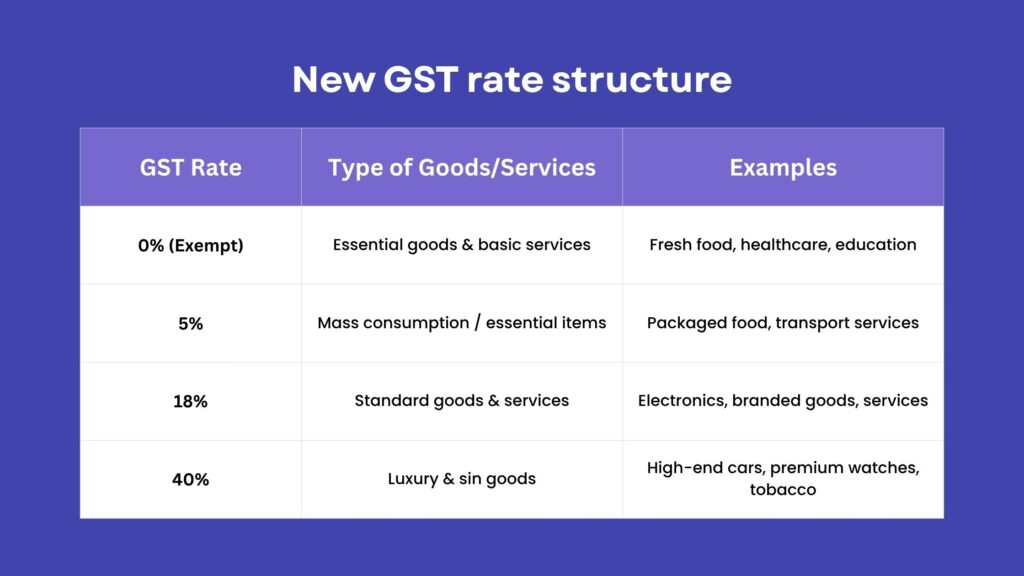
One of the most talked-about changes is GST rate rationalization. The old four-slab system (5%, 12%, 18%, 28%) caused a lot of confusion; businesses often did not know which rate to apply to their products. From April 2026, GST structure becomes cleaner and more logical.
What GSTchanges and what it means for your business
The 12% tax rate has basically been removed for most products. Most items that were previously taxed at 12% are now either at 5% (for essential goods) or 18% (for regular products). This change benefits everyday consumers, but businesses need to re-check their product HSN codes and tax rates immediately.
The main update for sellers of luxury items is that a new 40% tax now applies to luxury and “sin” products. Expensive cars, premium watches, and tobacco items are included in this category. If your business sells or distributes any of these products, you need to update your pricing and invoices immediately.
major relief for consumers: Individual health and life insurance plans no longer have GST. This is demand by public and the insurance industry for long time. Insurance companies will need to update their billing systems accordingly.
Note: Review every product and service your business sells. Cross-check HSN codes against the updated rate schedule. Incorrect GST rates on invoices can lead to penalties and ITC rejection for your buyers.
Strict rules for Tax Credit Claims
Input Tax Credit (ITC) is an important part of GST. It lets businesses get back the tax they paid on their purchases, which lowers their overall tax costs. But fake ITC claims have been a big problem in India’s GST system. Starting April 2026, the government is closing this loophole completely.
The Zero Mismatch policy
From 1 April 2026, GST portal enforces a Zero Mismatch Policy. If there is any difference between invoices shown in your GSTR-2B (what your supplier reported) and your GSTR-3B (what you claimed), the portal will now “block” your return filing until the error is fixed.
Earlier, mismatches were flagged but you could still file. That flexibility is gone. You can only claim ITC for invoices that your supplier has actually filed and reported on the GST portal.
Invoice Management System (IMS) is now mandatory
The Invoice Management System (IMS) is new feature on the GST portal that is now fully operational. Every invoice that your supplier uploads must be reviewed by you & must mark it as “Accept,” “Reject,” or “Pending.” Only accepted invoices qualify for ITC. This means businesses need to do weekly reconciliations between their purchase records and IMS dashboard. Monthly is no longer enough especially if you have a large number of suppliers.
- Weekly supplier tracking required
If your supplier does not file their GSTR-1 on time, you lose ITC for that invoice. You need to monitor supplier compliance weekly, not just at month-end. - ITC claims blocked at source
The portal now automatically blocks ITC claims that do not match supplier filings. Manual overrides are no longer possible for mismatched claims. - Supplier scorecard matters
Businesses are advised to rate and track their suppliers by their GST filing history. Low-compliance suppliers can cost you real money in lost ITC credits.
Businesses that were careless with managing their tax credits may face blocked filings, denied claims, and cash flow problems. On the other hand, businesses that keep accurate records will not face any issues and might even get their claims processed faster.
Stricter E-invicing rules
E-invoicing (electronic invoicing) in India means that businesses must upload their invoices to government’s Invoice Registration Portal (IRP), which generates unique Invoice Reference Number (IRN). From 2026, two rules that were introduced in 2025 are now fully enforced with no exceptions.
Rule 1: 30-Day IRN Reporting Window:
If your business has total annual turnover of ₹10 crore or more, you must generate an Invoice Reference Number (IRN) for every invoice within 30 days of invoice date. After 30 days, IRP portal will block IRN, this means invoice cannot be used by your buyer to claim tax credits. This rule applies to all tax documents, including invoices, credit notes, and debit notes. There is no grace period and no way to bypass it manually.
Rule 2: Case-Insensitive Invoice Numbers:
From June 2025 (now fully in effect in 2026), invoice numbers on the IRP are case-insensitive. This means that “INV-001” and “inv-001” are considered the same invoice. Businesses that use multiple billing systems or ERP tools need to make sure there are no duplicate invoice numbers, even if the letters are in different capitalisation.
Multi-Factor Authentication (MFA) is Mandatory for All
Multi-Factor Authentication (MFA) is now required for all GST portal users, not just large businesses. This was introduced in phases and became mandatory for everyone from April 1, 2025. MFA is now standard requirement. If your accountant or GST consultant tries to log in without MFA, their access will be blocked.
Quick tip: Make sure your billing software generates e-invoices in real time instead of waiting until end of the month. Creating the IRN on same day is the safest way and removes the risk of missing the 30-day deadline.
Faster Refunds and Better Cash Flow for Exporters
This is really good news, especially for exporters and small businesses (MSMEs). The government has introduced two important changes to the GST refund process, which will make getting cash refunds much faster.
Provisional Refunds for Inverted Duty Structure
If your business has an inverted duty situation where you pay more GST on purchases than you collect on sales, you have always been able to claim refund. but, process used to be slow. From April 2026, you can now get provisional refund of up to 90% of your claim while final verification is still underway. This is big improvement for cash flow, especially for manufacturers and traders in industries like textiles, agricultural equipment, and construction.
Minimum Refund Threshold Removed for Exporters
Previously, if your GST refund claim for exports was less than ₹1,000 government would not process it. That minimum limit has now been removed for IGST-paid exports. Even small claims will now be processed, which is good news for small exporters and small businesses (MSMEs).
Credit Notes and Post-Sale Discounts
A common area of confusion has been post-sale discounts and credit notes. From April 2026, rules are now clear if you give discount after sale and issue credit note, the buyer must adjust tax credit they claimed on original invoice. Both seller and buyer are now tracked clearly on GST portal. This change removes frequent source of disputes between buyers and sellers and also lowers risk of tax authorities sending scrutiny notices.
Tougher Registration Rules and Annual Compliance
Stricter GST Registration Process
To prevent fake invoices and fake companies, GST registration process in 2026 is now stricter. Physical checks of business locations are common for new registrations, especially in high-risk sectors. Aadhaar-based biometric verification is also being used in more states.
If you are starting new business in 2026–27 financial year, make sure your documents, address proof, and business premises are all correct before applying for GST registration. Incomplete or wrong applications are rejected more quickly, and you may have to wait before applying again.
Annual Returns: Blocked System for Non-Filers
The GSTR-9 (Annual Return) and GSTR-9C (Reconciliation Statement) for FY 2025–26 now have automatic late fees that go up every day you delay GST filing. The GST portal will also block you from filing current year’s returns if returns from previous years are still pending. This is not just warning it is strict system block. If you missed filing returns for FY 2023–24 or FY 2024–25, make sure to clear those immediately. Waiting will only make the situation worse.
LUT Filing for Exporters
If your business exports goods or services or sells to SEZs (Special Economic Zones), you must file fresh Letter of Undertaking (LUT) for FY 2026–27. LUTs are year-specific and cannot be carried forward. Not having valid LUT means you will have to pay IGST on exports and then wait for a refund, damaging your cash flow.
3-Year Return Deadline Portal Now Strictly Enforcing It
From December 2025 (now fully in effect in 2026), GST portal permanently blocks returns for periods older than three years. If you have unfiled returns from FY 2022–23 or earlier, you can no longer file or change them. This can create problems during audits. Make sure to address any pending assessments or scrutiny notices as soon as possible.
What Happens When You Don’t Follow the Rules
Non-compliance in 2026 is more expensive than ever. The GST portal now has automated penalty systems that charge late fees and restrict filings without manual intervention.
| Violation | Impact | Intensity |
| Missing 30-day IRN window | IRN permanently blocked; buyer loses ITC | High |
| ITC mismatch (GSTR-2B vs 3B) | Return filing hard-blocked until resolved | High |
| Pending Annual Returns (GSTR-9) | Current year returns blocked; escalating daily late fees | High |
| Incorrect GST rate on invoice | Penalty + demand notice + possible audit trigger | Medium–High |
| LUT not filed for exports | Must pay IGST upfront; refund delays | Medium |
| Fake invoice or inflated ITC | 100–300% penalty + potential prosecution | Very High |
| MFA not enabled on portal | Portal access restricted | Low–Medium |
Important GST Compliance Dates for FY 2026–27
- By 30 April 2026
File your LUT for FY 2026–27 if your business exports goods or services or sells to SEZs. - Ongoing from April 2026
Weekly IMS reconciliation: review and accept/reject invoices in the Invoice Management System every week. - 11th of every month
GSTR-1 filing deadline: all outward supply details must be filed by the 11th of the following month. - 20th of every month
GSTR-3B filing deadline: monthly summary return including tax payment. Ensure ITC is reconciled before filing. - By 31 December 2026
GSTR-9 Annual Return for FY 2025–26: file this on time to avoid the portal blocking next year’s returns. - Ongoing in 2026
e-Invoice within 30 days: for businesses above ₹10 crore AATO, generate IRN the same day you issue an invoice.
10-Point Checklist: Is Your Business GST-Ready for FY 2026–27?
- Review all products and services for updated HSN codes and the new GST changes rate structure (0%, 5%, 18%, 40%)
- Update your billing software and ERP to reflect the new GST rates from April 1, 2026
- Enable Multi-Factor Authentication (MFA) for all GST portal users in your organisatio
- Set up e-invoicing with same-day IRN generation (mandatory for ₹10 crore+ AATO businesses)
- Assign a team member to review and action the Invoice Management System (IMS) weekly
- Audit your supplier base — check which suppliers are late GST filers and follow up immediately
- File LUT for FY 2026–27 immediately if your business exports or sells to SEZs
- Clear all pending GSTR-9 and GSTR-9C filings for previous years — the system will block current year filings otherwise
- If you have an inverted duty structure, file for provisional refund claims to improve cash flow
- Brief your finance, accounts, and sales teams on the new GST rates, ITC rules, and e-invoice timelines
What These Changes Mean for Your Business Going Forward
The GST changes starting 1 April 2026 are the biggest since GST was introduced in 2017. The government is clearly moving toward fully digital, real-time tax system where mistakes and late filings are automatically penalised. On the positive side, businesses that are organised and follow the rules will actually benefit. Faster refunds, simpler tax credit processes, and clearer tax rates make administration easier for those with proper records. The biggest risk is doing nothing. Every day you delay updating your systems, filing your returns, or training your team increases your exposure to penalties, blocked filings, and cash flow problems.
Go through the 10-point checklist above and make sure your business uses the new rates from 1 April. Also check the new Income Tax Act that started from 1 April. In 2026, following GST and income tax rules is not just required by law it also helps your business run smoothly.
Read our related blogs:

2 comments
I have read so many articles concerning the blogger lovers except
this piece of writing is really a nice article, keep it up.
I pay a visit every day a few websites and information sites to read posts,
however this weblog offers quality based articles.