
If you sell products online whether on Amazon India, Flipkart, Meesho or ONDC (Open Network for Digital Commerce) there is one GST rule that catches most new sellers completely off guard that is ₹20 lakh exemption threshold does not apply to you.
For regular offline businesses in India, GST registration threshold is ₹20 lakh per year in most states (₹10 lakh in special category states) and those below this number don’t need to register or collect GST legally.
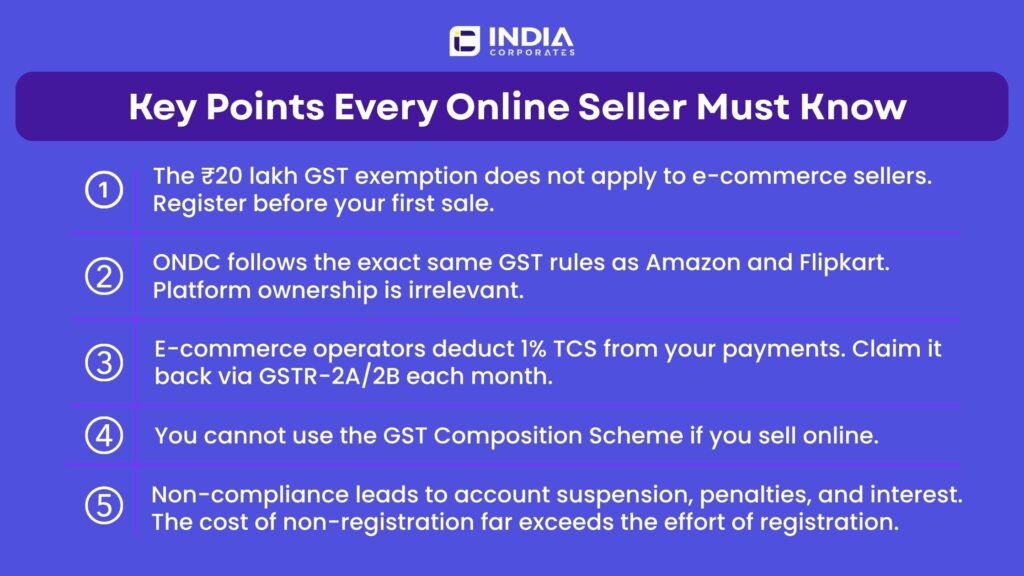
But for e-commerce sellers, this exemption does not exist even after the changes in GST from 1 April 2026. It doesn’t matter if you earn ₹50,000 a month or ₹5,000. The moment you list your product on any online marketplace, GST registration becomes mandatory. This is one of the most misunderstood aspects of GST for online sellers in India, and it applies equally if you’re selling on private platform like Amazon or on public network like ONDC.
What is ₹20 lakh GST Threshold and why it doesn’t cover online sellers
The GST Threshold (GST registration limit) for small businesses was introduced to give relief to small enterprises. If your annual turnover is below ₹20 lakh or (₹40 lakh for goods-only businesses in regular states since 2019), you can operate without registration under GST. This is for our neighbourhood kirana store, local tailor, small town service provider.
But Section 24 of CGST Act, 2017 creates specific rules for e-commerce sellers. This act creates list of certain categories of businesses that have compulsory GST registration, and turnover does not matter. E-commerce operations and suppliers who sell through them fall under this mandatory registration category.
The Law:
Section 24(ix) of the CGST Act states that any person who supplies goods or services through an e-commerce operator is required to obtain GST registration. There is no minimum turnover bar for this category. It is unconditional.
This means if you’re selling single handmade candle set on Amazon Handmade or listing your cloud kitchen on Swiggy Minis via ONDC, you need GSTIN before you receive your first payment.
ONDC vs Amazon: Does the Platform Matter for GST Rules?
This is where many sellers get confused. They assume that since ONDC is government-backed open network unlike Amazon or Flipkart which are private companies, it may be have different or friendlier GST rules. This assumption is incorrect.
The GST rules for e-commerce sellers is not depends on who owns or operates platform. It is depends on nature of transaction. If you sell goods or services through any online platform that connects buyers and sellers, you must register under GST. Even though ONDC is an open network, it is still an e-commerce system under GST rules.
| Feature | Amazon / Flipkart (Private Platforms) | ONDC (Open Network) |
| Platform type | Private marketplace | Government-backed open network |
| GST registration mandatory? | Yes, always | Yes, always |
| ₹20 lakh GST threshold applies? | No | No |
| TCS deducted by platform? | Yes — 1% (0.5% CGST + 0.5% SGST) | Yes — via buyer-side app (BAP) |
| Who collects TCS? | Amazon/Flipkart directly | Buyer App Operator (BAP) on ONDC |
| GSTR-8 filing required? | Filed by operator (Amazon/Flipkart) | Filed by buyer-side app operator |
| Seller claims TCS credit? | Yes, via GSTR-2A/2B | Yes, same process |
| Composition scheme available? | No — e-commerce sellers ineligible | No — same restriction |
From GST compliance perspective, selling on ONDC is same as selling on Amazon. The rules are same for things like compulsory registration, TCS deduction, and not being allowed to use composition scheme.
It donen’t matter if you sell through Amazon, Meesho or ONDC. if you’re using an online marketplace, GST registration is compulsory even if you earn ₹1.
What Is TCS and How Does It Affect E-commerce Sellers?
One of unique aspects of GST for e-commerce sellers is Tax collected at source (TCS). Under Section 52 of CGST Act, every e-commerce operator like Amazon, Flipkart or buyer-side app on ONDC is required to collect 1% GST as TCS before sending payments to sellers.
If you sell product worth ₹10,000 on Amazon, the platform will deduct ₹100 as TCS (0.5% CGST + 0.5% SGST) and pay you ₹9.9000. Platform then deposits this ₹100 with government and files monthly GSTR-8 return mentioning your GSTIN and amount deducted. You can then claim this ₹100 as credit in your own GSTR-3B
TCS on ONDC- who collects it?
ON ONDC, Buyer App Provider (BAP) for example, Paytm, Magicpin, acting as buyer app is responsible for deducting and depositing TCS. The seller app (SAP) you use to list your products does not collect TCS. This is important because it decides in whose GSTR-8 your TCS credit will show up.
For you as seller, process of claiming TCS credit in GST is same across all platforms: check your GSTR-2A/2B for TCS entries filed by operator and claim credit in your GSTR-3B under “TDS/TCS credit received”. This is real cash flow consideration TCS is deducted from every payment and you need to actively claim it back.
Why E-commerce Sellers Cannot Use the GST Composition Scheme
The GST Composition Scheme is another tax relief measure that small businesses love. Under this scheme, eligible businesses can pay GST at lower fixed rate (around 1-6% depending on type of business) and file simpler quarterly returns. This makes compliance much easier.
However, Section 10 of CGST Act states that businesses that sell through any e-commerce platform cannot choose this scheme. If you sell goods or services online you are not eligible, with no exceptions. This rule applies to all platforms, including ONDC-based apps like Dunzo, Blinkit (partner sellers) or any other seller app connected to ONDC.
Why this matters for your business
Without access to GST Composition Scheme, online sellers file monthly or quarterly GST returns (GSTR-1 and GSTR-3B) maintain detailed invoice records, reconcile TCS credits and comply with full range of regular GST obligations. This creates extra administrative work, especially for new sellers or small business owners.
Step-by-Step: How to Register for GST as an Online Seller
Getting GST registration as an online seller involves detailed, step-by-step process on government portal. You need to gather multiple documents, fill out forms carefully, upload everything correctly, complete verification, and then wait for approval. It can be time-consuming and sometimes confusing especially if you’re doing it for the first time.
Instead of going through all this hassle, you can simply get help from Indiacoporates professional service provider. Just share your basic documents, and their experts will handle the entire process for you from application to approval so you receive your GST certificate without stress.
And it doesn’t stop at registration. You also get ongoing support like GST return filing, compliance management, and other related services, making it much easier to run your business smoothly.
ONDC and the Future of E-commerce GST Compliance in India
ONDC (open network for digital commerce) is Indian government’s ambitious initiative to make e-commerce more open and accessible. Instead of being tied to just one platform, sellers can list their products once and be visible across many buyer apps like Paytm, PhonePe, and Magicpin. The goal is to give small businesses, kirana stores, local artisans and MSMEs fair chance to compete with bigger, platform-driven businesses.
But this openness creates new challenge for GST compliance on ONDC. because multiple buyer apps are involved in single transaction and each BAP is responsible for TCS, seller could theoretically appear in GSTR-8 filings from multiple operations in same month and reconciliation becomes more complex.
Government has been working on clearer GST usidelines specifically for ONDC based transactions, particularly around inter-state sales, place of supply determination and how returns like GSTR-1 should handle ONDC-specific invoice formats.
Penalties for Non-Compliance: What Happens If You Don’t Register?
If you don’t register for GST and avoid paying tax, you may have to pay a penalty equal to the tax amount. For example, if your GST due is ₹50,000, you will have to pay an extra ₹50,000 as penalty along with the original tax.
- Minimum penalty of ₹10,000: even if your actual tax liability is low, the minimum penalty for non-registration is ₹10,000.
- Interest at 18% per annum on unpaid taxes from the date they were due.
- Account suspension by the e-commerce platform: Amazon, Flipkart, and ONDC operators are required to verify seller GSTINs. A missing or invalid GSTIN can result in your account being flagged or deactivated.
- In serious cases, if someone intentionally avoids paying tax of more than ₹5 crore, it can lead to criminal action.
Practical GST Compliance Checklist for E-commerce Sellers
Whether you’re new to online selling or have been operating for while, use this checklist to make sure you’re on right side of GST compliance for e-commerce:
- Obtain GST registration before making your first sale on any online platform
- Update your GSTIN on all marketplace seller profiles (Amazon Seller Central, Flipkart Seller Hub, ONDC seller app)
- Issue GST-compliant invoices for every sale, including your GSTIN, HSN/SAC code, tax rate, and buyer details
- File GSTR-1 monthly or quarterly (depending on your turnover) to report your outward supplies
- File GSTR-3B monthly to report net tax liability and claim input tax credits including TCS
- Check GSTR-2A/2B every month to reconcile TCS credited by platform operators
- Maintain books of accounts with sales register, purchase register, and stock records
- Get a GST audit done if your turnover exceeds ₹2 crore in a year (applicable for self-certification above ₹5 crore)
- Remember: do NOT opt for Composition Scheme if you sell on any e-commerce platform
FAQ
No. ONDC-enabled buyer apps and seller apps require a valid GSTIN as part of onboarding. Even if your turnover is below ₹20 lakh, mandatory e-commerce registration rule applies. You must register before you start selling.
The law does not distinguish between full-time and part-time online sellers. If you are supplying goods or services through an e-commerce platform, GST registration is mandatory. There is no hobby exemption.
Not necessarily. Registration means you must collect and remit GST on taxable supplies. Many goods (like fresh vegetables, grains, books) are either GST-exempt or zero-rated. You only pay GST on items that fall under a taxable GST slab. But you still need to be registered regardless.
No. Your existing GSTIN works across all platforms. GST registration is tied to your business entity (PAN), not to individual platforms. You can use the same GSTIN on Amazon, Flipkart, ONDC, Meesho, or any other marketplace.

5 comments
This is a really clarifying piece on a common misconception among sellers. I’ve seen many entrepreneurs assume they’re exempt from GST registration just because their turnover is below the threshold, not realizing the special rule for e-commerce sellers. It’s great that the article highlights how this applies to platforms like ONDC and Amazon alike, making it easier for sellers to plan their compliance early on.
This clarification about GST for online sellers is really eye-opening. Many small sellers assume the ₹20 lakh threshold protects them, but knowing that registration is mandatory from day one can prevent serious compliance issues.
Thank you for breaking this down — it’s surprising how many new sellers don’t realise the ₹20 lakh threshold doesn’t apply to online sales. The mandatory registration and TCS piece especially is something I wish I’d understood earlier when prepping product photos and listings for marketplaces. A useful read for anyone starting out on Amazon, Flipkart or ONDC.
Really helpful breakdown of how the ₹20 lakh GST threshold does not carry over to e-commerce sellers. The TCS credit workflow section is especially useful for anyone listing on Amazon, Flipkart or ONDC for the first time. I also appreciate the clear note that the Composition Scheme simply is not available for online sellers — that alone would have saved me hours of confusion when I was setting up my first marketplace listings.
Glad to see this myth-busting piece on the Rs 20 lakh GST threshold for online sellers. The point about the Composition Scheme being unavailable and the mandatory GSTIN on Amazon, Flipkart and ONDC has tripped up several new sellers I know. Step-by-step compliance like this saves a lot of late-filing headaches once TCS starts showing up.