
In today’s connected world, global trade is no longer limited to big companies or multinational brands. Small business start-ups, manufacturers, traders, and even individual entrepreneurs can now import or export goods across borders with the right knowledge and support.
Words like customs duties, import regulations, export compliance, IEC code, and documentation can sound intimidating to beginners. However, it does not have to be difficult; that’s why India Corporate comes with an easy solution: IEC registration.
Understanding Import-Export Today’s Global Market
The import-export business buys goods from one country (importing) and sells them in another, or sells locally made products abroad (exporting). This can include raw materials, finished products, machinery, food items, textiles, electronics, handicrafts, and industrial goods. This type of business helps countries trade with each other and allows companies to reach new markets.
With global demand rising and online platforms expanding, international trade has become a powerful growth opportunity.
In today’s global market, it is important for businesses to follow import-export compliance, which means following rules and laws related to international trade. These rules are set by governments to make sure trade is safe and legal. Businesses must correctly describe their goods, declare the right value, and pay required taxes and duties. If the information is wrong, shipments can be delayed or stopped, and companies need to pay fines.
Note: Companies need to be careful about restricted countries and products. Trading with banned countries or selling restricted items can cause serious legal problems. Checking trade rules before doing business helps avoid these risks.
Why global trade matters for businesses
- Access to bigger markets
- Higher profit potential
- Diversification of business risks
- Better pricing opportunities
- Brand recognition across borders
- Competitive advantage
Import-Export Duties
Import and export duties have multiple taxes applied during cross-border trade, calculated on factors like goods value, origin, and type. These duties protect domestic industries, fund governments, and regulate trade flows. Imports have higher charges than exports in most countries. Details vary by nation, but common structures are built on a base duty plus add-ons.
Types of duties
- Anti-dumping duty
Used when goods are imported at very low prices to protect local manufacturers - Customs duty
This is a basic tax applied when goods enter the country - Basic customs duty (BCD)
Charged based on the value of imported goods - Integrated Goods and Services Tax (IGST)
Applied to imports in many countries to match domestic tax rules
How are duties calculated based on
- Product value
- Product category
- HS code (harmonized system code)
- Country of origin
Trade agreements
Tip: Knowing the correct HSN code is extremely important to avoid penalties
- Import duty
Basic Customs Duty (BCD) is the main tax on imported goods, valued at 5-20% based on product type. Integrated Goods and Services Tax (IGST) adds to BCD plus freight costs, typically 5-28%. Other fees cover social welfare surcharges, anti-dumping duties for cheap imports, and safeguard duties for market floods. - Export duties
Exports usually have low or zero duties to boost sales abroad, but some raw materials face specific rates like ad valorem (percentage of value) or fixed per unit. In places like India, duties apply to items like iron or leather to control supply.
Import-Export Regulations
Every country has rules and regulations to control what comes in and goes out. These regulations make sure of safety, quality, and legal trade. Import-export regulations help to protect consumers, maintain product quality, prevent illegal trade, keep national security, and control restricted items.
- Import Rules
When importing goods, you may need: an import license, product certification, quality inspection, labelling compliance, customs clearance document. Some products, like food, chemicals, medicines, and electronics, require special approvals.
Goods fall into free (no extra okay slip), limited (needs a license), banned (not allowed), or special channel (only through special agencies). Use HS codes to check your item’s group. Submit documents like the bill of entry, invoice, packing list, and origin certificate at customs. Import licenses last 18-24 months and allow buys from any country.
- Export Rules
For export, regulations usually include: export license (for restricted items, country-specific compliance, quality standards, packaging and labelling norms, shipping documentation
Classify export as free, restricted (license required), prohibited, or through state firms. Get an export license for controlled goods, plus a certificate of origin and declaration. Use schemes like Advance Authorisation for duty-free input if you export later. Check the buyer country rules too.
Why IEC is Important
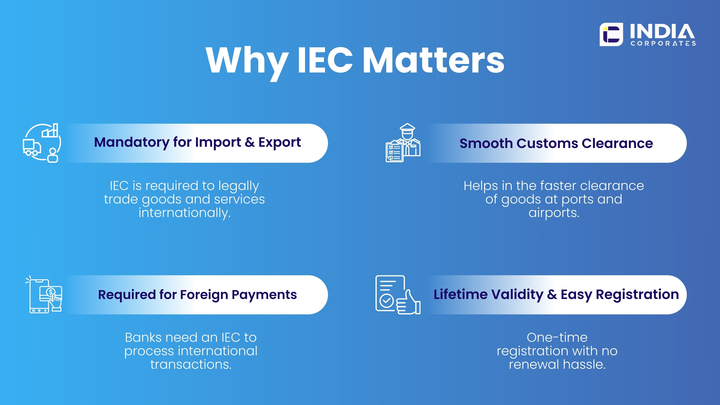
The Import Export Code (IEC) is an important number needed by anyone who wants to buy or sell goods or services across countries. It is given by the government and is required for all import and export activities. Without this code, a person or a business cannot do international trade. The IEC is used by banks for foreign payments and by customs to clear goods. It is easy to get, valid for a lifetime, and helps businesses trade smoothly and legally with other countries.
Without an IEC, you cannot import & export goods and cannot clear customs. IEC is required by traders, manufacturers, exporters, importers, proprietors, companies, LLPs, partnership firms, and even small businesses and startups that need an IEC if they want to trade globally.
Benefits of IEC registration
IEC registration has many useful benefits for businesses and individuals involved in international trade. It gives legal permission for global trade, allowing a person or business to import and export goods or services without problems. The IEC has lifetime validity, so once it is issued, there is no need to renew it again.
The registration process is simple and done online, which saves time and effort. An IEC is required for customs clearance, as customs officers ask for this code to allow goods to move in or out of the country. Without it, goods may get delayed.
IEC also helps in getting export benefits offered by the government, such as financial support and incentives. These benefits can help reduce costs. Having an IEC also builds trust with foreign buyers, as it shows that the business is registered and allowed to trade internationally.
IEC registration process
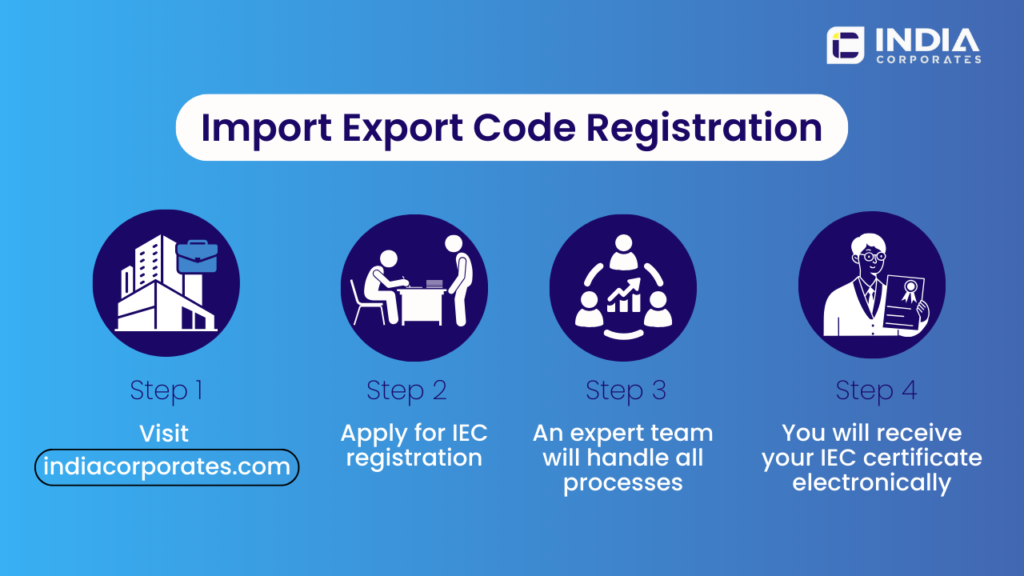
- Visit India corporate
- Apply for IEC registration
- An expert team will handle all processes
- You will receive your IEC certificate electronically
Common challenges in the import-export business
- Complex regulations- each country has different trade laws, licenses, and rules, which can be confusing for new traders.
- High duties and taxes- Import duties, customs fees, and other charges can increase the cost of goods
- Incorrect documentation- Small mistakes in invoices, shipping bills, or licenses can lead to penalties or shipment delays
- Delays in clearance- goods may be held at the port due to inspections, missing documents, or customs backlog
- Payment risks- there is a risk of fraud, late payments, or buyers not paying at all
- Currency fluctuations: Changes in exchange rates can reduce profit or increase losses
How to overcome these challenges
- Learn basic trade rules: Study import-export processes, duties, and required documents
- Use professional support: take help from customs agents, trade consultants, and freight forwarders
- Stay updated with regulations: regularly check government updates and trade notifications
- Verify buyers and suppliers: Confirm company details and use safe payment methods
- Insure shipments: protect goods against damage, theft, or loss during transport, for safe delivery
- Use trusted logistics partners: Choose reliable shipping companies for timely and safe delivery
- Plan costs carefully: calculate all charges in advance to avoid unexpected expenses
- Maintain proper records: keep all trade documents organized for future reference and audits.
Final thoughts: Growth Strategy, Not Just a Rule
Global business may look difficult at the beginning, but it becomes simple when you understand the basics. Understanding import-export duties helps businesses plan costs better and avoid unexpected expenses. Knowing and following trade regulations ensures that goods move smoothly without legal issues or delays. Having a valid IEC is essential as it gives legal approval to take part in international trade and builds trust with banks, customs, and foreign buyers
With the right information, proper planning, and timely support, businesses can easily handle common challenges in global trade. Using professional guidance, staying updated with rules, and choosing reliable partners can save time and reduce risks. Overall, import-export trade becomes more manageable and profitable when businesses focus on compliance, clarity, and correct processes, making global growth possible and sustainable.

No comments yet