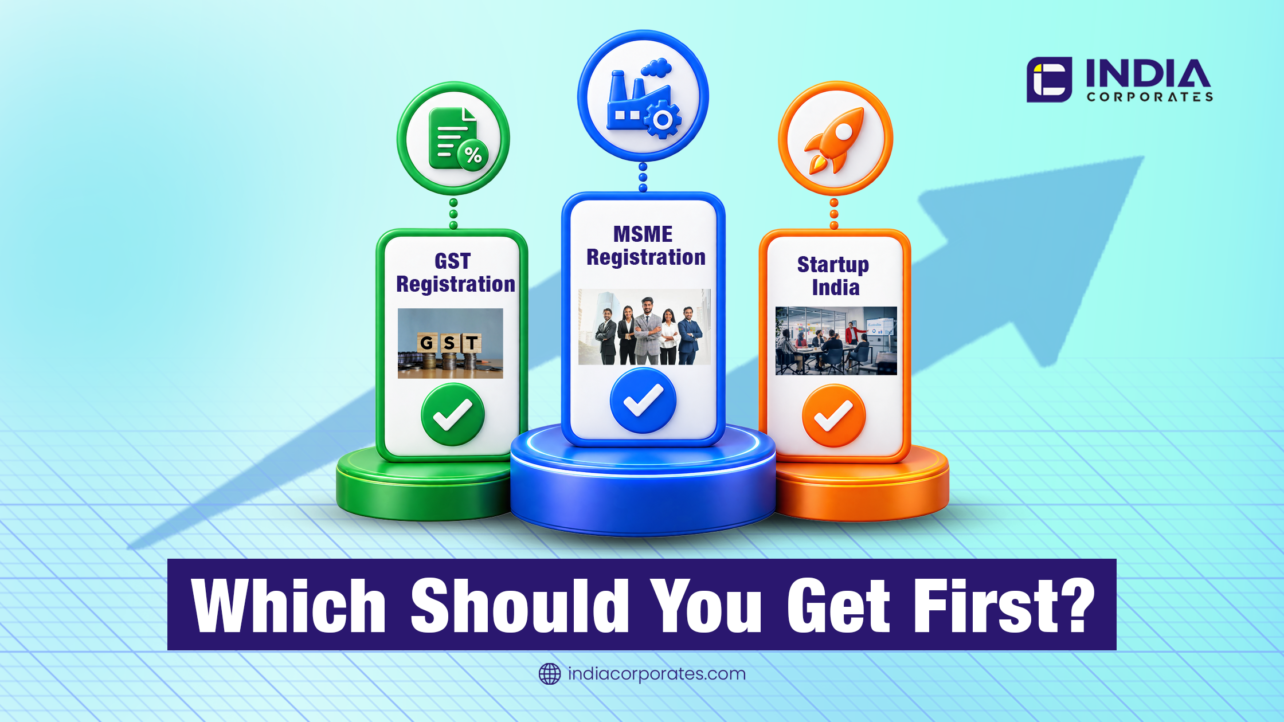
Starting a business in India comes with important question: which business registration should I get first GST registration? MSME registration? Startup India?
The answer is not same for every business. These registrations serve different purposes:
- GST Registration is mainly about indirect tax compliance.
- MSME/Udyam Registration identifies your business as a Micro, Small or Medium Enterprise and can help you access government benefits.
- Startup India/DPIIT Recognition is designed for eligible innovative and scalable startups and can provide access to certain startup-focused benefits.
Common mistake is to think that one registration replaces another. But no you can not replace them, and in many cases business can have GST registration, udyam registration, DPIIT startup recognition at same.
Which business Registration Should You Get First?
| GST Registration | GST compliance and GSTIN | When GST registration is mandatory or when voluntary registration is useful for the business |
| MSME / Udyam Registration | MSME recognition and access to eligible benefits | When the business qualifies as an MSME, usually at an early stage |
| Startup India / DPIIT Recognition | Recognition for eligible startups | After forming an eligible business entity and meeting the applicable DPIIT conditions |
A practical order for many new businesses
Business incorporation/registration → GST Registration (if applicable) → Udyam Registration → DPIIT Startup Recognition (if eligible)
But this is not fixed legal sequence for every business. Your business structure, turnover, type of supply and plans can change the order.
What Is GST Registration?
GST Registration is the registration required under the Goods and Services Tax system. After registration, a business receives a GSTIN (Goods and Services Tax Identification Number). A registered business may need to charge GST on taxable supplies, issue GST-compliant invoices, maintain records and file applicable GST returns.
When is GST Registration required?
GST Registration is generally required when your business crosses the applicable turnover limit or falls under a category where registration is compulsory.
- Services: Usually ₹20 lakh annual turnover.
- Goods: Usually ₹40 lakh in many states.
- Lower limits or special rules may apply in certain states and situations.
- Businesses below the threshold may also register voluntarily.
Why does GST Registration matter?
- Makes your business legally compliant with GST rules.
- Gives you a GSTIN for issuing GST invoices.
- Allows eligible businesses to claim Input Tax Credit.
- Helps build trust with customers and other businesses.
- May be necessary to work with certain companies, marketplaces or government buyers.
- Helps you avoid penalties for failing to register when registration is mandatory.
What Is MSME or Udyam Registration?
MSME registration is now commonly known as Udyam Registration. It is the Government of India’s official registration system for Micro, Small and Medium Enterprises.
Who can be an MSME?
From 1 April 2025, the MSME classification is based on investment and turnover:
- Micro Enterprise: Investment up to ₹2.5 crore and turnover up to ₹10 crore.
- Small Enterprise: Investment up to ₹25 crore and turnover up to ₹100 crore.
- Medium Enterprise: Investment up to ₹125 crore and turnover up to ₹500 crore.
A small manufacturer, service provider, trader or other eligible enterprise may fall under the MSME framework depending on the applicable rules.
What are the benefits of Udyam Registration?
- Access to MSME-focused schemes.
- Easier identification as an MSME.
- Support connected with eligible government programs.
- Possible access to credit-related or financial support schemes.
- Benefits under applicable delayed-payment protection provisions.
- Opportunities under certain government procurement programs.
What Is Startup India Registration?
Startup India Registration is process through which an eligible business can get official startup recognition from Government of India through DPIIT. It helps startups access various government benefits, tax benefits, funding support, intellectual property support and easier compliance options.
Why get DPIIT Startup Recognition?
DPIIT Startup Recognition gives your business official startup recognition from Government of India; it can also make your startup eligible for several government benefits.
- Tax benefits: Eligible startups can apply for certain income-tax benefits.
- Patent and trademark support: Faster processing and support for intellectual property applications.
- Easier government tenders: Startups can get relaxation in some public procurement requirements.
- Self-certification: Eligible startups can self-certify compliance with certain labour and environmental laws.
- Easier business closure: Certain rules make it easier for eligible startups to wind up their business.
- Better credibility: Government recognition can help show that the business is a recognised startup.
Which One Should You Get First?
Situation 1: Your GST Registration is mandatory
If your business is required to register for GST, GST registration should be your first priority. Do not delay mandatory tax registration because you are planning to apply for Udyam Registration or Startup India recognition. For example, if you start service business and your turnover reaches applicable GST registration limit, you should first complete your GST registration and follow required GST rules.
Situation 2: your GST registration is not mandatory yet
Suppose you have recently started small business and GST registration is not mandatory at this stage. If your business qualifies as MSME, Udyam Registration can be good early step. After permanent Udyam Registration Number, you can consider whether voluntary GST registration is useful for your business and are you eligible for DPIIT Startup Recognition.
Situation 3: You are building innovative startup business
Suppose you have started technology company, product company or scalable service business, you should first set up appropriate business entity. After that, check whether your business is eligible for DPIIT Startup Recognition under Stratup India programme. You should also check whether GST registration is mandatory for your business. If GST registration is required, you must complete it as required. If your business qualifies as MSME, you can also consider Udyam Registration.
Important: A new business does not automatically qualify as a recognised startup. DPIIT Startup Recognition is available only to businesses that meet applicable eligibility conditions.
GST Registration vs MSME Registration vs Startup India
| Feature | GST Registration | Udyam / MSME Registration | Startup India / DPIIT Recognition |
| Main purpose | GST compliance | MSME recognition | Startup recognition |
| Main authority/system | GST authorities | Ministry of MSME | DPIIT / Startup India |
| Tax registration | Yes | No | No |
| GSTIN issued | Yes | No | No |
| Udyam number issued | No | Yes | No |
| DPIIT recognition | No | No | Yes |
| Based mainly on turnover? | GST rules apply | Investment + turnover | Turnover + age + other conditions |
| Suitable for every business? | If GST law applies | Eligible MSMEs | Only eligible startups |
| Does it replace GST? | — | No | No |
| Does it replace Udyam? | No | — | No |
| Does it replace DPIIT recognition? | No | No | — |
Final Answer: Which Should You Get First?
There is no single registration that every business must get first.
But a simple rule works for many entrepreneurs:
GST first if GST registration is legally mandatory. Udyam Registration can be an early step for eligible MSMEs. Startup India/DPIIT recognition should be considered when your business meets the startup criteria.
If you are a small business owner, Udyam Registration can be useful even when GST registration is not yet compulsory. And if GST registration is mandatory for your business, tax compliance should not be postponed while waiting for another registration. The most important thing is to understand that GST Registration, MSME/Udyam Registration and Startup India recognition are not competing registrations. They serve different purposes and, where eligible, can work together.
For professional assistance with business registration, GST, MSME/Udyam registration and business compliance, you can explore [IndiaCorporates]

No comments yet