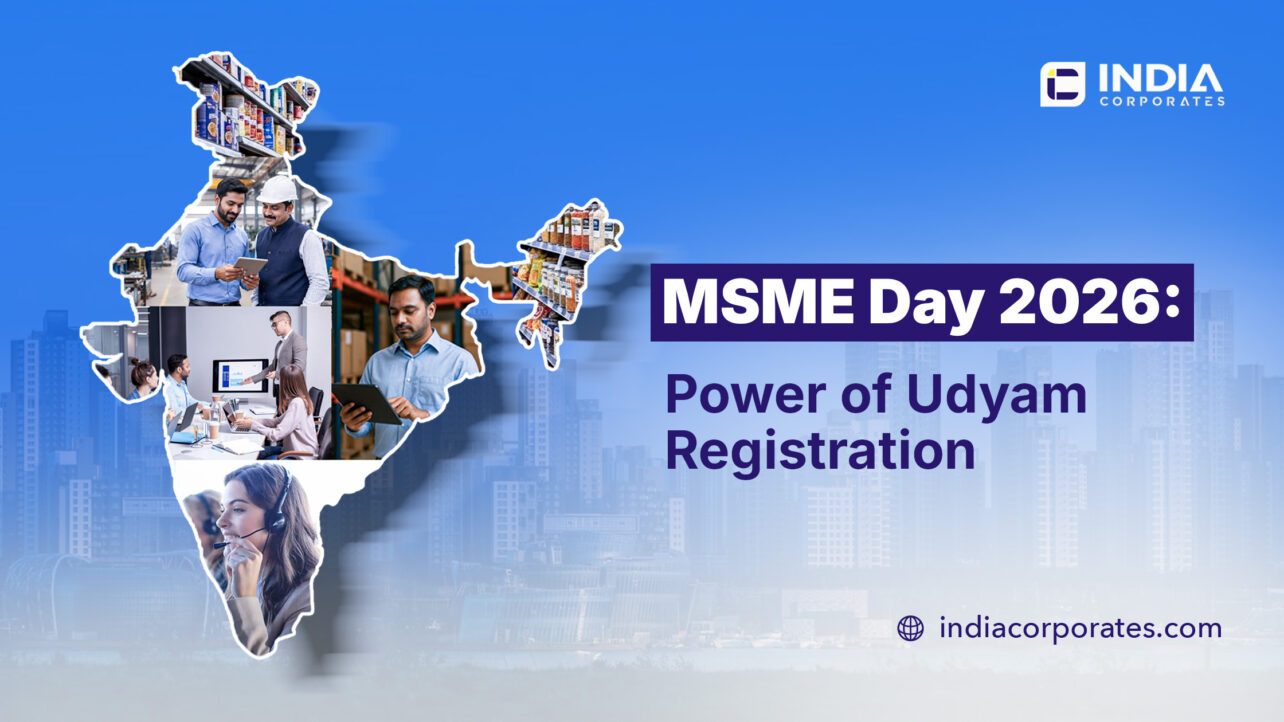
Every year on June 27, India celebrates MSME Day a moment to recognize 6.3 crore+ micro, small and medium enterprises (MSMEs) that play an incredible role in India’s growth. MSMEs contribution to GDP: 31.1% nearly third of the country’s GDP, backbone of India’s international trade: 48.58%, innovation and employment generation.
To celebrate this day Ministry of MSME is hosting MSME Day 2026 event on Saturday, 27 June 2026 at 10.00 AM at Dr. Ambedkar International Centre, 15 Janpath Road, New Delhi.
The program is being organized by Ministry of MSME, Government of India for MSME Day 2026. The chief guests are listed as Shri C. P. Radhakrishnan (Vice President of India), Shri Jitan Ram Manjhi (Minister for MSME) and Sushri Shobha Karandlaje (Minister of State for MSME).
How many MSMEs are present in India?
The government’s push for formal registration has helped registration on central systems quickly, now more people and businesses are signing up for MSME registration.
According to real-time official metrics from Ministry of MSME Dashboard, there are over 7.86 crore (78.6 million) registered enterprises across India.
- Micro Enterprises (4.97 Crore units): over 95% of registered businesses fall into this category. These businesses have investments below ₹1 crore and annual turnover below ₹5 crore
- Small Enterprises (5.38 lakh units): medium-sized businesses with investments of up to ₹10 crore and annual turnover of up to ₹50 crore
- Medium Enterprises (41,601 units): larger businesses that have investments of up to ₹50 crore and annual turnover of up to ₹250 crore
What Types of MSME Businesses Exist?
- Trading Enterprises (42.89%)
This is largest category among registered MSMEs. It includes businesses involved in buying and selling goods and plays important role in supply chain.
- Wholesale distributors of consumer goods and construction materials
- Local retail stores, online sellers, direct-to-consumer (DTC) businesses and commodity traders.
- Service Enterprises (36.22%)
This category has grown quickly because it is easier to start and expand compared to many other businesses
- Professional services: Technology startups, SaaS companies, legal firms, accounting firms, and compliance consultants.
- Hospitality & logistics: Small hotels, logistics providers, transport agencies, and repair service centers.
- Healthcare & education: Medical clinics, diagnostic labs, coaching centers, and training institutes.
- Manufacturing enterprises (20.89%)
This category includes businesses that produce physical goods for domestic and international markets
- Textiles, garments, and leather products.
- Automotive components, electronic parts, tools, and machinery parts.
- Food processing, pharmaceuticals, packaging products, and chemical products.
How MSMEs contribute to economic growth
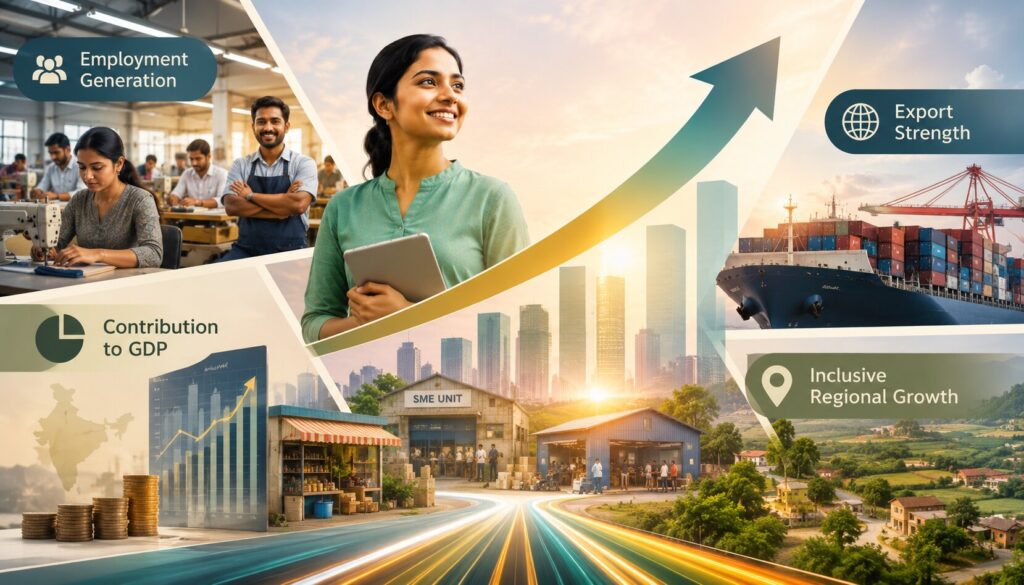
MSMEs are often called the foundation of entrepreneurship in India. MSMEs play an important role in supporting India’s economy through four major contributions:
Employment Generation
MSMEs are second largest source of jobs in India after agriculture. They support livelihoods of over 34.6 crore (346 million) people. Since they need less investment per worker than large companies, they provide important job opportunities in rural and semi-urban areas.
Contribution to GDP
MSMEs make a major contribution to India’s economy. It contributes 31.1% of the country’s total GDP and 35.4% of its manufacturing output. This shows how important they are in producing goods, creating value, and supporting overall economic growth.
Export Strength
Small businesses play a strong role in global trade. They contribute 48.58% of total shipments abroad. They export wide range of products, from local handicrafts to advanced engineering components, and generate nearly half of India’s foreign exchange from merchandise trade.
Inclusive Regional Growth
MSMEs play an important role in inclusive regional development. Instead of being limited to tier-1 cities like large corporations, they operate widely in rural areas and tier-2 and tier-3 towns. This helps balance economic activity across regions, encourages the use of local resources, creates jobs closer to where people live, and reduces migration to already crowded cities.
Why MSME Day is important
The global economy is becoming more competitive than ever. Small businesses are facing several challenges, including rising operational costs, limited access to credit delayed payments from buyers and increasing market competition. These pressures make it harder for MSMEs to grow, invest and sustain operations even they play key role in jobs, production, exports and regional development.
To support them, the Government of India has introduced and strengthened several schemes for MSMEs over the years, aimed at improving credit access, reducing financial stress, and encouraging business growth.
MSME Day 2026 holds special significance because it comes at time when small businesses are at center of economic recovery and growth. The day is also an opportunity for governments, industry bodies, and financial institutions to reflect on how policies are working on the ground and what more can be done to reduce barriers for small businesses. It helps raise awareness about existing support systems and encourages more MSMEs to become part of the formal economy.
In 2026, MSME Day is especially relevant as digital transformation, global supply chain shifts, and changing consumer demand are creating both new opportunities and new challenges for small businesses. The focus is increasingly on improving ease of doing business, expanding access to finance, and strengthening competitiveness.
Importance of MSME Udyam Registration
Udyam Registration is official government registration process for Micro, Small, and Medium Enterprises (MSMEs) in India. It formally recognizes businesses under MSME category and makes them eligible for various government schemes, incentives, and support programs.
Udyam Registration helps businesses unlock wide range of benefits such as access to funding, subsidies, government tenders, and legal protections designed specifically for MSMEs. Without this registration, many businesses may miss out on these opportunities and support systems. Even registered businesses may not fully utilize all the benefits available to them.
For unregistered businesses, MSME Day 2026 is an important reminder to understand what support and opportunities they could be missing.
Benefits of Udyam Registration
#1: Collateral-Free Loans Up to ₹5 Crore
Udyam-registered MSMEs can access collateral-free loans of up to ₹5 crore through government-backed schemes like CGTMSE. This means businesses don’t need to get personal or business assets to get funding. With government support, loans are often easier to get, may have lower interest rates, and get faster approval.
#2: The 45-Day Payment Guarantee
Udyam-registered MSMEs are protected under the MSMED Act, Udyam-registered MSMEs must be paid within 45 days by their buyers. If payment is delayed, the buyer has to pay high interest as per law.
Check more details about MSME Payment Protection Under Indian Law: The 45-Day Payment Rule.
#3: Government Procurement Priority
Udyam-registered MSMEs get priority access to government tenders under the 25% procurement reservation policy. Through platforms like the Government e-Marketplace (GeM), MSMEs can easily participate in public procurement and bid for contracts. This opens up large business opportunities that were earlier limited to big companies, allowing MSMEs to supply goods and services directly to the government.
#4: 50% Subsidy on Trademark and Patent Registration
Udyam-registered MSMEs can get a 50% subsidy on trademark registration fees. This makes it easier and more affordable for small businesses to protect their brand name and logo. It helps MSMEs secure their identity legally without high costs, encouraging more businesses to register and protect their intellectual property.
#5: ZED Certification
The Zero Defect Zero Effect (ZED) scheme helps MSMEs improve product quality and reduce environmental impact. Certified MSMEs can get subsidies for certification costs, easier access to export opportunities, and preference in some government tenders. It is a useful step for businesses aiming to expand into global markets.
#6: Faster Cash Flow via TReDS Invoice Discounting
Udyam-registered MSMEs can use TReDS (Trade Receivables Discounting System) to get quick access to cash by selling unpaid invoices. Instead of waiting 60–90 days for payments, businesses can convert their pending bills into immediate funds through the platform.
#7: State-Level Capital, Interest, and Electricity Subsidies
Udyam-registered MSMEs can also access various state government schemes, which often include capital subsidies, interest subsidies, electricity bill exemptions, and support for upgrading technology.
Final thoughts
MSME Day is not just about recognition, it is also reminder to take closer look at what your business is actually eligible for. The reality is that Udyam Registration is only the first step. Many business owners register once, receive their certificate, and do not check system and they often miss out on new schemes and benefits introduced over time.
With major initiatives such as the ₹45,000 crore export support package and the ₹10,000 crore equity funding push under India’s long-term vision of Viksit Bharat@2047, the MSME support ecosystem is expanding continuously.
That is why MSME Day 2026 should be more than celebration. It is an opportunity to log into udyam portal, update key business details like turnover and investment and check which benefits you may already be eligible for. Or get Udaym registration now
Udyam Registration is not just a compliance step. It is an access point to financial support, protection, and growth opportunities. The real value depends on how actively it is used.

No comments yet