
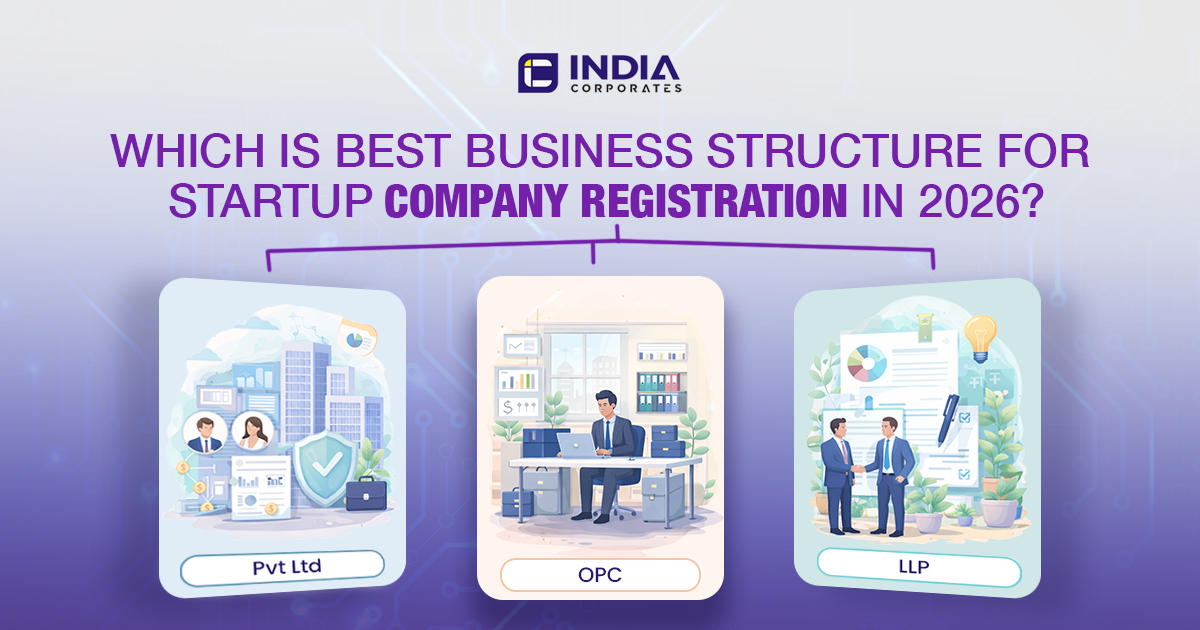
Do you have a startup business idea in mind but feel confused about which company registration is right for you? Or want to know what the first step is to start a business in 2026?
Many entrepreneurs focus on product ideas, branding, marketing and funding, but ignore one of the most important decisions at the beginning: choosing the right legal structure for their startup.
Before you apply for business registration, open a bank account or pitch to investors, decide on your choice between Private Limited Company, LLP (Limited Liability Partnership), OPC (One Person Company), Partnership Firm, or Public Limited Company. Your business structure will impact your taxation, compliance, funding ability, ownership control, and long-term growth.
Choosing the wrong structure can lead to legal risks, unnecessary taxes, compliance penalties or difficulty in raising investment. In 2026, startup company registration in India has become digital and faster, but selecting the correct legal structure requires clarity and proper planning. By the end of this article, you will clearly understand which business structure is best for your startup idea and how to take the first step toward successful company registration in 2026.
Why Your Business Structure Matters in 2026
Choosing the right legal structure is not just legal documentation; it is the foundation of your startup. The structure you select on day one will influence how your business operates, grows, pays taxes, attracts investors, and even how it exits in the future. In 2026, stratup ecosystem is more competitive and compliance-driven. Investors, banks and even customers prefer dealing with structured and legally registered businesses, and a properly registered company increases trust, improves brand image and helps to get contracts easily.
Choosing the right legal structure affects:
- Personal liability protection
- Ability to raise startup funding
- Business credibility
- Tax benefits
- Compliance burden
- Exit options
- Ownership transfer
Business structure in India
Private Limited Company
A Private Limited Company (Pvt Ltd) is the most preferred structure for startups planning to scale. It is registered under the Companies Act, 2013 and regulated by the Ministry of Corporate Affairs (MCA). If your startup goal in 2026 includes scaling fast, raising funding, or expanding internationally, a Private Limited structure gives you a strong foundation.
Key Legal Requirements
- Minimum 2 directors (at least 1 resident Indian director)
- Minimum 2 shareholders
- Maximum 200 shareholders
- Registered office address
- Digital Signature Certificate (DSC)
- Director Identification Number (DIN)
Major Benefits of a Private Limited Company
1. Limited Liability Protection
In a Private Limited Company, the liability of shareholders is limited to the amount of capital they have invested in the company. This means that if the business faces losses, if the company is unable to repay debts, or if there are legal claims; The personal assets of shareholders (like house, car, personal savings) are protected.
2. Separate Legal Entity
The company has its own legal identity, separate from its owners. This means the company can own property in its own name, open a bank account, enter into contracts, sue and be sued, and borrow money. Even if directors or shareholders change, the company continues to exist as an independent entity.
3. Easy Fundraising
One of the biggest advantages of a Private Limited Company is its ability to raise capital efficiently.:
- Issue equity shares
- Issue preference shares
- Raise venture capital
- Attract angel investors
- Raise venture capital funding
- Offer Employee Stock Option Plans (ESOPs)
- Secure private equity investment
Investors strongly prefer Pvt Ltd structures due to shareholding clarity.
4. Perpetual Succession
The company continues to exist even if shareholders change, the death or resignation of directors does not affect its existence, and ownership can be transferred through share transfer. For startups planning long-term operations, acquisitions, or mergers, perpetual succession is a major advantage.
Compliance Requirements (Important for 2026)
- Annual ROC filings
- Board meetings (minimum 4 per year)
- Annual General Meeting (AGM)
- Statutory audit (mandatory regardless of turnover)
- Maintenance of statutory registers
Taxation
Private Limited Companies are taxed under corporate tax provisions:
- 22% corporate tax (subject to conditions)
- Additional surcharge and cess are applicable
Private Limited Company registration is best for:
- Tech startups
- Funded startups
- SaaS companies
- E-commerce businesses
- Startups planning IPO in future
Limited Liability Partnership (LLP)
A Limited Liability Partnership (LLP) is a popular business structure for small and medium-sized businesses in India. It combines the operational flexibility of a traditional partnership with the advantage of limited liability protection. An LLP is governed by the Limited Liability Partnership Act, 2008, and is registered with the Ministry of Corporate Affairs (MCA).
Legal Requirements
- Minimum 2 partners
- No maximum limit
- At least 1 resident designated partner
- LLP Agreement required
Major benefits of LLP
- Limited Liability – Partners are not personally liable for the negligence, fraud, or misconduct of other partners. Their financial risk is limited to the capital contribution made to the LLP.
- Flexible profit sharing – Profits are distributed according to the number of shares held. LLPs offer customizable profit-sharing arrangements. Partners can decide any profit ratio in the LLP Agreement, depending on capital contribution. This flexibility allows founders to reward active partners more or distribute profits based on effort, role, or expertise. Profit-sharing changes can be updated easily through amendments in the LLP Agreement, without affecting the legal structure.
- Lower compliance – LLPs have significantly lower regulatory and compliance requirements than others. No mandatory Annual General Meeting (AGM), No board meeting requirements, Audit requirements are conditional, Simple record maintenance:
Taxation of LLP in 2026
- Taxed at 30% flat rate
- No dividend distribution tax
- Profit distribution to partners is tax-free (subject to rules)
Best For
- Consultants
- Chartered accountants
- Lawyers
- Small service businesses
- Family-managed businesses
One Person Company (OPC)
One Person Company (OPC) was introduced under the Companies Act, 2013, to encourage solo entrepreneurs to start their own businesses with limited liability protection. Before OPC was introduced, individual founders had to choose between a sole proprietorship (which has unlimited liability) or forming a private limited company (which requires at least two members). OPC solved this by allowing a single individual to form a company while having a corporate structure.
In 2026, OPC continues to be a strong option for freelancers, consultants, digital creators, and small startup founders who want credibility and legal protection.
Legal Requirements
- Only 1 member
- 1 director
- Nominee mandatory
- Separate legal entity
Benefits of OPC
- Full control Over Business Decisions
In an OPC, there is only one shareholder, which means no conflicts between partners, no delay in decision-making, no voting disputes, Clear ownership structure. The single owner has full authority over operations, strategy, hiring, investments, and expansion. - Limited Liability Protection
The biggest advantages of OPC are limited liability. The owner’s liability is limited to the amount invested in the company. If the company faces Business losses, Legal claims, or financial liabilities, personal assets of the owner (such as house, car, savings) are generally protected.
Compliance
- Annual filings required
- Audit required
- Conversion to Pvt Ltd mandatory if paid-up capital or turnover exceeds limits prescribed under the Companies Act
Taxation
- Taxed as a Private Limited Company
- Corporate tax applicable
Best For
- Freelancers
- Digital entrepreneurs
- YouTubers
- Online sellers
- Individual consultants
How to Decide the Right Legal Structure
Selecting the right legal structure for your startup depends on your business goals, number of founders, funding plans, and future growth. Every business has its own structural advantages, so you can only decide about your business’s future.
If you are starting alone and want full control with limited compliance, you can go with the OPC (One Person Company); it can be good for you. If businesses started with two or more partners who want flexibility and formalities, an LLP is preferred. If you are planning to raise investment or build a strong corporate structure, then a Private Limited Company is the best choice.
Compliance and legal responsibilities are another important factor in the company. Private Limited companies have more regulatory requirements, while LLPs and OPCs generally have comparatively simpler compliance. Before taking any decision, it’s always a good idea to consider taxation, ownership structure and long-term business plans.
Many startups also consult professionals before registration to ensure they choose a structure that supports their growth, funding opportunities, and operational flexibility in the long run.
Final Thoughts
Choosing the right business structure is one of the most important decisions when starting a company in 2026. Whether you are choosing a Private Limited Company, LLP, or OPC, each structure is designed to suit different types of businesses and entrepreneurs.
If you want strong credibility and investor-friendly structure, a Private Limited Company can be the correct option. If you want greater flexibility and fewer compliance requirements, an LLP may be more suitable. For solo entrepreneurs starting small, OPC provides a structured way to run a business with limited liability.
The key is to align your business structure with your vision, growth plans, and operational needs. Taking the time to understand these options will help you build a strong foundation for your startup and support your business success in the future.

No comments yet